Resources / Knowledge Base
Singapore Company Bank Account Opening and Compliance
Why Singapore company bank account opening depends on ownership records, nominee arrangements, business rationale, source of funds and compliance evidence.

Why Singapore company bank account opening depends on ownership records, nominee arrangements, business rationale, source of funds and compliance evidence.

For a Singapore company, incorporation does not automatically lead to a corporate bank account. Banks assess the company as a regulated customer: who owns and controls it, why it was incorporated in Singapore, how it will be funded, who will operate the account and whether the expected transactions make commercial sense. A well-maintained corporate and compliance file does not guarantee account approval, but it makes the banking review clearer, faster to explain and less exposed to avoidable uncertainty.
Singapore company incorporation can be efficient. Once the company is registered, the Accounting and Corporate Regulatory Authority (ACRA) record confirms that the company exists and identifies key particulars such as its name, officers, shareholders and registered address. A bank account application is different. The bank is not merely checking whether the company exists; it is deciding whether to enter into an ongoing regulated financial relationship.
That decision requires the bank to understand the customer, the persons behind the customer, the business purpose, the expected account activity and the risk profile. For a foreign-owned company, the review may be more detailed because shareholders, beneficial owners, directors, customers, suppliers and group companies may be located in several jurisdictions.
The practical message is simple: incorporation creates the legal vehicle; banking requires the vehicle to be understandable, evidenced and commercially coherent.
Banks in Singapore operate under a regulated anti-money laundering, countering the financing of terrorism and countering proliferation financing framework. MAS Notice 626 and the related guidance require banks to apply customer due diligence, understand beneficial ownership, assess risk, and monitor whether transactions are consistent with what is known about the customer and its business.
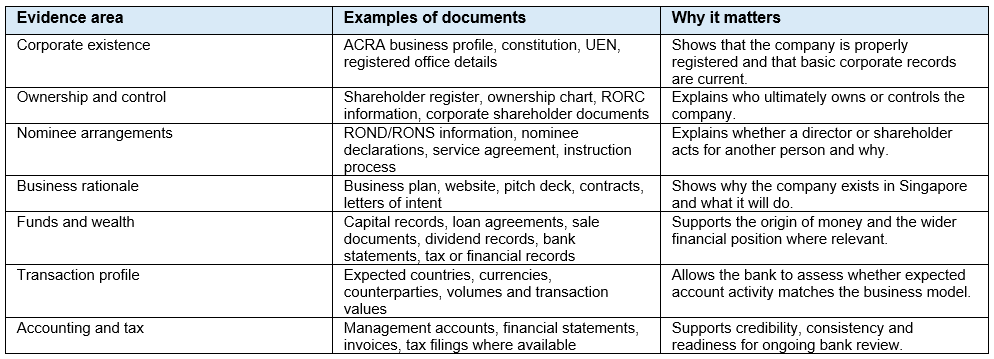
This is why a bank may ask for more than the certificate of incorporation, ACRA business profile or constitution. Those documents prove existence. They do not fully explain ownership, source of funds, source of wealth, commercial rationale or expected transaction behaviour.
Ownership and control are central to a Singapore bank account application. The registered shareholder is not always the ultimate beneficial owner. A Singapore company may be owned by an individual, a foreign holding company, a layered group, a nominee shareholder, a trustee or a family arrangement.
The bank may ask for an ownership chart from the Singapore company to the ultimate individual beneficial owners. Where corporate shareholders exist, it may request incorporation documents, registers of members, certificates of good standing, group charts, constitutional documents and identity evidence for the persons who ultimately own or control the structure.
Control may also arise without simple majority ownership. Voting rights, rights to appoint or remove directors, nominee arrangements, contractual rights, shareholder agreements or other influence may be relevant. For this reason, the company’s Register of Registrable Controllers (RORC) and beneficial ownership file should be treated as part of the banking evidence base, not only as statutory paperwork.
Nominee arrangements may be legitimate in Singapore, but they require transparent explanation. A nominee director may be used to satisfy the local resident director requirement. A nominee shareholder may hold shares for another person or entity. The banking question is not merely whether the arrangement exists, but who the nominator is, who gives instructions, who exercises control, and why the arrangement is commercially justified.
ACRA’s current company-register framework requires companies, unless exempt, to maintain accurate statutory registers, including RORC, Register of Nominee Directors (ROND) and Register of Nominee Shareholders (RONS), and to file required information or updates with ACRA’s central registers. The Corporate Service Providers Act 2024 also tightened the framework for corporate service providers and nominee directorship arrangements by way of business.
A nominee arrangement should therefore not be left as an undocumented private understanding. It should be supported by statutory registers, declarations, board records, engagement documents and a clear explanation of decision-making authority.
Banks often ask why the company has been incorporated in Singapore. The answer should be practical, specific and consistent with the company’s records. Acceptable commercial reasons may include Asian market entry, regional management, trading, technology services, consultancy, investment holding, supply-chain coordination, treasury support, intellectual property management or access to Singapore’s professional and financial infrastructure.
Substance does not always mean a large office or a full local team from the first day. It may be shown through governance, directors who understand the business, contracts or draft contracts, business plans, accounting records, professional advisers, board approvals, Singapore-facing activity and a clear role within a wider group.
Weak explanations such as “we only need a bank account” or “we do not yet know what the company will do” can make the file harder to support. A bank is likely to assess whether the Singapore company fits logically within the owner’s wider business structure.
Source of funds and source of wealth are related but different. Source of funds explains the origin of the specific money to be paid into the company, used for paid-up capital, provided as a shareholder loan or applied to a transaction. Source of wealth explains how the beneficial owner or group accumulated its broader financial position.
Source-of-funds evidence may include bank statements, shareholder loan agreements, capital injection records, sale and purchase agreements, dividend vouchers, invoices, contracts, investment statements or audited financial statements. Source-of-wealth evidence may include business ownership records, asset-sale evidence, tax records, financial statements, investment portfolio statements or other independent records.
Not every bank will request the same evidence. The depth of review depends on the bank, the business activity, countries involved, nominee or layered ownership features, expected transaction values and the bank’s risk assessment. The company should nevertheless be ready to support the funding story with documents, not only narrative.
A bank normally wants to understand how the account will operate. The company should be able to describe expected incoming and outgoing payments, principal currencies, monthly transaction volumes, approximate transaction sizes, main customers and suppliers, countries involved, related-party payments and the types of goods or services involved.
The transaction profile should align with the stated business activity. A consultancy company with substantial payments from unrelated high-risk jurisdictions, a trading company with no supplier contracts, or an investment holding company receiving large funds without investment documents may all face additional questions. A transaction profile does not need to predict every future payment, but it should give the bank a credible operating picture.
Assume two foreign-owned Singapore companies both apply for accounts. Company A has one individual shareholder-director, a simple consultancy model, signed customer engagements, modest expected monthly payments and clear employment savings used for initial capital. Company B has three corporate shareholders, a nominee director, expected payments from several jurisdictions, shareholder loans from a third party and no signed contracts yet.
Both companies may be legitimate. However, Company B will usually require a deeper explanation. The bank may need a group chart, corporate documents for each shareholder, nominee arrangement documents, source-of-funds evidence for the loans, details of the third-party payer and a clearer business plan. This difference does not necessarily mean inconsistent treatment; it reflects different risk profiles.
Accounting and tax compliance are not separate from banking in practice. During onboarding or periodic review, a bank may request financial statements, management accounts, invoices, tax filings, contracts or evidence of historical activity. Poor bookkeeping can make a company appear unclear, inactive, informal or higher risk.
This is particularly important where the company has cross-border transactions, shareholder loans, intercompany balances, foreign currency movements or related-party payments. A company that maintains accurate accounting records, files annual returns, prepares tax filings and updates statutory registers is easier to explain to a bank.
A professional corporate service provider can help prepare the corporate file, maintain ACRA records, organise beneficial ownership information, prepare statutory registers, document nominee arrangements, prepare board resolutions, coordinate certified documents and align company secretarial, accounting and tax records.
It may also help prepare a concise business profile, ownership chart, transaction profile and response pack for bank questions. This is useful because a coherent file is easier to review and less likely to create avoidable inconsistencies.
However, a corporate service provider cannot guarantee account approval, override a bank’s internal risk decision, conceal beneficial ownership, invent commercial substance or submit unsupported source-of-funds explanations. Its proper role is to help the company present an accurate, complete and verifiable file.
Eltoma may assist foreign-owned Singapore companies with corporate administration, statutory registers, beneficial ownership files, nominee-arrangement documentation, accounting coordination and preparation of a structured corporate file for banking review. This support does not guarantee bank account opening, but it helps the company approach the process with clearer records and stronger compliance evidence.
Opening a bank account for a Singapore company should be prepared as a compliance project, not as the final administrative step after incorporation. Incorporation documents are necessary, but they are not sufficient.
Banks assess ownership, control, substance, source of funds, source of wealth, nominee arrangements, business rationale and expected account activity. For foreign-owned Singapore companies, the quality of the corporate and compliance file can make a meaningful difference.
A well-maintained file improves the prospects of a smoother banking review. It does not guarantee account opening, but it places the company in a stronger, more credible and more professionally prepared position.
No. Incorporation confirms that the company legally exists, but a bank account is subject to the bank’s own customer due diligence, risk assessment and internal approval. The bank will normally review ownership, control, business rationale, source of funds, source of wealth and expected account activity before deciding whether to open an account.
A bank needs to understand who ultimately owns or controls the company. The registered shareholder may be a holding company, nominee, trustee or another legal arrangement. An ownership chart and supporting documents help the bank identify the persons behind the structure and assess whether the business relationship is coherent and transparent.
A nominee director is not automatically a problem, but the arrangement must be transparent, documented and commercially explainable. The bank may ask who the nominator is, who gives instructions, who controls the account and whether the nominee arrangement is consistent with the company’s governance and beneficial ownership file.
Source of funds explains the origin of the specific money used in the company or transaction, such as capital, a shareholder loan or trading proceeds. Source of wealth explains how the beneficial owner or group accumulated its wider financial position over time, for example through business ownership, salary, dividends, asset sales or investments.
A well-prepared file normally includes the ACRA business profile, constitution, board resolution, registers, ownership chart, identity documents, nominee records where applicable, business plan, contracts or invoices, source-of-funds documents, expected transaction profile and accounting or tax records where available.
No. A corporate service provider can help prepare the company’s records and banking file, but it cannot override a bank’s internal risk decision or guarantee approval. Its role is to help the company present accurate, complete and verifiable information in a professionally organised manner.
Accounting and tax records help demonstrate that the company’s actual activity is consistent with its stated business model. Banks may request management accounts, invoices, contracts or tax filings during onboarding or review, especially where the company has already traded or has cross-border, related-party or multi-currency transactions.

Immigration

Legal Business

Tax

Presentations

Tax Magazines

Guideline Article

Template

Checklist

eBook

Webinar

Our technical content is authored by ELTOMA's senior professionals with deep experience scos corporate services, legal, tax and compñance in international markets.
Speak with our experts about your cross-border
corporate and compliance requirements.
We will respond within one business day.

ELTOMA has been delivering international corporate, tax, and compliance solutions since 2004, helping businesses establish, operate, and grow across key global markets.

Receive updates with practical insights on international business, law, tax, accounting, and compliance.
Be the first to hear about our latest discounts and special offers!
Follow our Telegram channel for offshore industry news:
Want updates by e-mail?
Enter your email address below to subscribe to our newsletter!