Resources / Knowledge Base
Cyprus FDI Screening 2026: Thresholds, Sectors and Approval
Understand Cyprus FDI screening under Law 194(I)/2025: 25% and €2m thresholds, strategic sectors, review timelines, penalties and deal-planning steps.

Understand Cyprus FDI screening under Law 194(I)/2025: 25% and €2m thresholds, strategic sectors, review timelines, penalties and deal-planning steps.

On 2 April 2026, Cyprus brought into force its first comprehensive foreign direct investment screening regime. The Establishment of a Framework for the Screening of Foreign Direct Investments Law of 2025, Law 194(I)/2025, gives the Ministry of Finance power to review qualifying investments that may affect the security or public order of the Republic.
For private equity sponsors, family offices, strategic buyers and international corporate groups, this creates a separate regulatory workstream alongside company law, merger control, sectoral licensing, sanctions, financing and tax. The practical question is no longer simply whether the acquisition documents are valid. It is also whether the transaction may legally complete before the Ministry has issued its decision.
The regime is not a general restriction on foreign capital. It is a targeted screening mechanism. Its significance is greatest where the target operates infrastructure, technology or services that the Law treats as strategically sensitive, or where the acquisition structure gives a third-country investor material influence over such a target. [1][2]
The ordinary notification obligation under section 3 requires the following conditions to be considered together:

If all three elements are met, the investor should treat FDI clearance as a pre-closing condition. The investment may not be completed merely because the application has been submitted; written approval is required.
The percentage analysis is not limited to registered legal title. Indirect participation, concert parties, voting arrangements and rights capable of producing decisive influence may all be relevant. In transaction due diligence, the ownership chart should therefore be read together with the shareholders' agreement, reserved matters, veto rights, board appointment rights and financing arrangements.
The €2 million threshold is not a universal safe harbour. The Law contains a separate notification trigger where an investor increases an existing participation from below 25% to 25% or more, or from below 50% to 50% or more. These threshold-crossing rules may apply regardless of the value of the additional investment.
This point is particularly important for staged acquisitions, venture capital rounds, earn-outs, option exercises and shareholder restructurings. A transaction that was below the ordinary filing threshold at entry can become notifiable later when the investor's rights or participation increase.
The Cyprus framework identifies a foreign investor by reference to persons and undertakings connected with countries outside the European Union, European Economic Area and Switzerland. However, the analysis cannot stop at the jurisdiction of the immediate acquisition vehicle.
The Law also addresses structures in which foreign investors have relevant shareholdings, beneficial ownership or control. The Ministry's published material specifically indicates that an investment may be caught where a foreign investor holds at least 25% of an investing undertaking, even if that undertaking is incorporated in another jurisdiction.
Accordingly, inserting an EU holding company between a third-country owner and the Cyprus target should not be assumed to take the transaction outside the screening regime. Advisers should map the entire ownership and control chain, identify the ultimate beneficial owners, and review any contractual rights that confer material or decisive influence.
Share acquisitions are the obvious case, but FDI screening should also be considered in mergers, joint ventures, staged investments, internal reorganisations, certain asset acquisitions and transactions involving land or property connected with strategic infrastructure. The statutory test must be applied to the substance of the transaction rather than its label.
A specific exemption applies to investments relating to ships under construction or ships being sold and purchased, but not to floating storage and regasification units (FSRUs). That exemption should not be extended by analogy to ports, energy terminals, data infrastructure or other strategically sensitive assets.
For complex group transactions, the safest approach is to identify precisely what rights move at completion: shares, votes, board representation, contractual control, access to sensitive information, operating assets and strategic land. Those rights determine whether an apparently technical restructuring has regulatory significance.
The Annex to Law 194(I)/2025 identifies particularly sensitive areas including energy, transport, water, health, education, tourism, communications, media, data processing and storage, aerospace, defence, electoral infrastructure and financial services, including systemic credit institutions. It also extends to critical technologies and inputs, including artificial intelligence, robotics, semiconductors, cybersecurity, quantum technologies, biotechnology, dual-use items and access to sensitive information. [2]
The fact that an undertaking operates in one of these broad industries does not necessarily make every investment notifiable. The target's actual activities, the sensitivity of the relevant asset or technology, the investment structure and the statutory thresholds must be considered together.
For real estate investors and developers, the distinction between ordinary commercial property and land that is essential to the use of strategic infrastructure is particularly important. A hotel, school, data centre site or logistics property should therefore be analysed by reference to its function, not merely its asset class.
The Ministry of Finance is the Screening Authority. Applications are submitted electronically using the prescribed English-language notification form and supporting documents. The government service is free of charge and permits filing by an authorised representative. Submission generates a reference number, but does not itself authorise completion. [1][3]
The information requirements are extensive. They include details of the parties and ultimate beneficial ownership, transaction value, business activities and NACE classification, source and structure of financing, proposed completion date, countries of operation, turnover, personnel, sanctions exposure and specified criminal matters.
A consistent filing requires more than a completed form. The ownership chart, transaction documents, financing explanation and commercial narrative should all describe the same structure. Inconsistencies can lead to information requests and, in turn, delay the statutory timetable.
The statutory process has two principal stages. First, within 20 working days after receipt of a complete application, the Ministry decides whether the investment should undergo in-depth screening. If screening is required, the Ministry then has 65 working days from that decision to assess whether the investment may affect security or public order.
Requests for additional information suspend the relevant statutory period until the requested material is supplied. There is no deemed approval mechanism. A notifiable investment must await the Ministry's written decision.
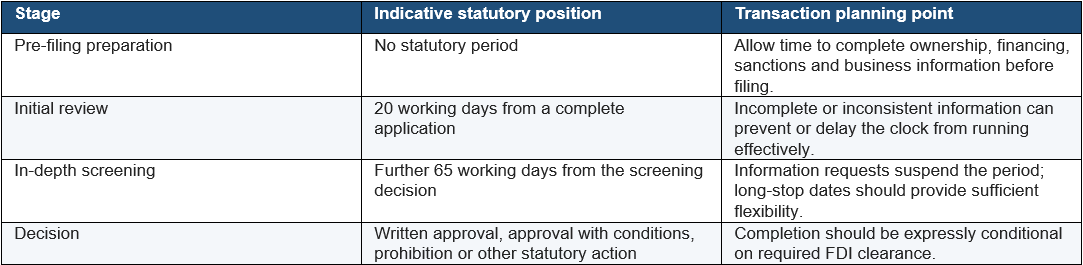
Following its assessment, the Ministry may approve the investment, impose mitigating conditions, prohibit it or, in appropriate cases, order termination or reversal. The Law also permits restrictions on voting, management or control rights where imposed measures are not observed. Transactions requiring prior approval are treated as subject to a suspensive condition for that approval.
Administrative sanctions are material. The current framework provides for:
The Ministry's decisions are administrative acts and may be challenged before the Administrative Court under Article 146 of the Constitution.
The screening power is not confined to transactions that were notified in advance. Where there are reasonable grounds to consider that a foreign direct investment may affect security or public order, the competent authority may examine certain investments that were not subject to mandatory notification within 15 months after completion.
Where an investment should have been notified but was not, the review period may extend to five years from completion. This residual jurisdiction matters for buyers, sellers, lenders and warranty-and-indemnity insurers because a weak filing analysis can remain relevant long after the deal has closed.
For borderline cases, transaction counsel should therefore record the basis on which the filing decision was made and retain the supporting ownership, sector and valuation analysis.
FDI screening should be moved to the beginning of the transaction timetable. For private equity and venture capital investors, minority positions cannot be dismissed simply because control is not acquired in the traditional company-law sense: board representation, veto rights and other governance rights may be relevant to decisive influence.
A practical transaction workflow is:
For corporate service providers, lawyers and tax advisers, the value lies in coordinating these workstreams rather than treating FDI clearance as a filing exercise performed immediately before completion.
Cyprus's present regime operates within the EU cooperation framework established by Regulation (EU) 2019/452. Under that framework, other Member States and the European Commission may exchange information and raise security or public-order concerns, while the national screening decision remains with Cyprus.
Regulation (EU) 2026/1386, adopted on 17 June 2026, will replace Regulation (EU) 2019/452. It entered into force in July 2026 and will apply generally from 17 January 2028. Certain provisions concerning implementation, systems and institutional preparation have applied since 16 July 2026. Regulation (EU) 2019/452 therefore remains relevant to current screening and transitional cases until the new regime becomes generally applicable. [4][5]
The new Regulation will increase harmonisation across the Union, including common minimum screening requirements and enhanced coordination for multi-country transactions. Cross-border acquisition structures that require filings in several Member States will therefore increasingly need a coordinated European timetable.
Cyprus remains open to international investment, but acquisitions involving strategically important undertakings now require a structured FDI analysis before signing and completion. The core questions are who ultimately controls the investor, what rights are being acquired, whether the transaction reaches the relevant percentage and value thresholds, and whether the target operates in a strategically sensitive area.
For notifiable transactions, approval is a genuine closing condition. For non-notifiable or borderline transactions, a documented legal analysis can reduce post-completion uncertainty. FDI screening should therefore sit alongside corporate, tax, sanctions, merger-control and financing analysis at the outset of the deal, rather than being treated as an administrative formality at the end.
This article provides general information as at 30 October 2026 and does not constitute legal, investment or regulatory advice. The current Ministry of Finance form, guidance and legislation should be checked at the date of any proposed filing.
No. The ordinary mandatory filing test requires the relevant qualifying holding or decisive influence, the statutory investment-value threshold and a target undertaking of strategic importance. Separate threshold-crossing rules can also apply.
For the ordinary test, the investment must generally result in at least a 25% participation in share capital and/or voting rights, or comparable decisive influence, and the investment value must be at least €2 million, subject to the strategic-target requirement.
Yes. A further acquisition that takes an investor from below 25% to 25% or more, or from below 50% to 50% or more, may trigger notification regardless of the value of the additional investment.
Not necessarily. The Cyprus rules require a look-through assessment of relevant foreign ownership and control. The jurisdiction of the immediate acquisition vehicle is not, by itself, determinative.
No. Submission is not approval. A notifiable foreign direct investment must not be completed before the competent authority issues its decision.
The Law provides an initial 20-working-day stage to determine whether in-depth screening is required, followed, where applicable, by a 65-working-day screening period. Information requests suspend the relevant period.
Yes. Certain non-notifiable investments may be reviewed within 15 months after completion, while an investment that should have been notified but was not may remain reviewable for up to five years.
Where filing is required or reasonably anticipated, the transaction documents should normally address FDI approval as a condition precedent, cooperation on information requests, allocation of regulatory risk and an appropriate long-stop date.

Immigration

Legal Business

Tax

Presentations

Tax Magazines

Guideline Article

Template

Checklist

eBook

Webinar

Our technical content is authored by ELTOMA's senior professionals with deep experience scos corporate services, legal, tax and compñance in international markets.
Speak with our experts about your cross-border
corporate and compliance requirements.
We will respond within one business day.