Resources / Knowledge Base
Cyprus Trusts Funds and Residency 2026 | Eltoma
Explore Cyprus International Trusts, AIFs, AIFLNPs, RAIFs, tax residence and relocation planning for families, investors and founders.

Explore Cyprus International Trusts, AIFs, AIFLNPs, RAIFs, tax residence and relocation planning for families, investors and founders.

Cyprus is frequently considered by international families, investors and entrepreneurs because it combines three legal features that are not always available in one jurisdiction: a common-law trust environment, an EU-regulated investment funds sector and a residence framework capable of supporting family relocation, business presence and tax-residence planning. For clients from third countries, including Russia, Ukraine and China, the strategic question is not whether Cyprus offers a single attractive product, but whether the trust, fund, corporate, tax and immigration elements can be made to operate as one coherent structure.
The legal analysis should therefore begin with purpose. A family seeking succession planning may require a Cyprus International Trust or a private trustee structure. A sponsor raising capital may require an Alternative Investment Fund, an AIF with Limited Number of Persons or a Registered Alternative Investment Fund. A founder relocating management functions to Cyprus may require an employment or business residence route, payroll and substance analysis. A private investor may require permanent residence by investment but not necessarily Cyprus tax residence.
The principal professional risk is to treat Cyprus trusts, funds and residency as interchangeable planning tools. They are not. They sit within separate statutory and regulatory regimes, each with its own evidence requirements, governance expectations, tax consequences and anti-money laundering obligations.
Cyprus International Trusts are governed by the International Trusts Law of 1992, Law 69(I)/1992, as amended. The regime is significant because it permits the use of a common-law trust structure within an EU Member State, while preserving flexibility for international settlors and beneficiaries.
In broad terms, a Cyprus International Trust is normally relevant where the planning objective is wealth preservation, succession, family governance, asset segregation, confidentiality, philanthropy, or the coordinated holding of international assets. It is not merely a tax product and should not be presented as such. A properly drafted trust must reflect the settlor’s objectives, the class of beneficiaries, the intended asset base, the dispositive provisions, trustee powers, protector arrangements, and any reserved powers.
The statutory conditions are central. The trust must remain international in character; at least one trustee must be resident in Cyprus, and the residence position of the settlor and beneficiaries at the relevant time must be analysed carefully. The trustee should also be capable of administering the structure with proper records, due diligence, accounting information and governance evidence.
Cyprus law allows considerable flexibility in the drafting of trustee powers and settlor-reserved powers. This is commercially useful for family offices and founders who wish to retain a degree of influence over investment direction, appointment of trustees, underlying companies or protector arrangements. However, excessive control may create tax, asset-protection or beneficial ownership risks in other jurisdictions. The trust deed should therefore be drafted with cross-border defensibility in mind, not only with Cyprus law compliance in mind.
The asset-protection features of Cyprus International Trusts are often emphasised in professional materials. That protection should be described with precision. A trust is not a device for defeating existing creditors or avoiding lawful claims. The relevant statutory framework and limitation periods may be favourable, but the factual background, timing of transfers, solvency position and foreign law risk must be reviewed before any asset-protection conclusion is given.
Confidentiality also requires careful drafting. The trust deed itself is not a public document in the manner of a company constitution. Nevertheless, modern Cyprus practice is no longer a secrecy regime. Trustees and professional service providers operate within anti-money laundering, beneficial ownership and supervisory frameworks. CySEC maintains the Cyprus Trusts Beneficial Owners Registry for express trusts and similar legal arrangements, and relevant information must be maintained, submitted or made available in accordance with the applicable rules.
A private trustee company may be used where a family or group wishes to have a dedicated corporate trustee for one or more related trusts. This can assist with continuity, familiarity with the family assets, faster trustee decision-making and closer integration with underlying holding companies, investment accounts or family business interests.
However, a private trustee company should not be described as automatically outside regulation. Where a Cyprus company provides trustee, fiduciary or administrative services, the analysis must consider the Administrative Services framework, anti-money laundering obligations, the identity of the trustees and directors, the scope of activity and whether the arrangement is genuinely private or conducted by way of business. CySEC guidance also makes clear that trust registration obligations may apply even where the trustee is not an administrative services provider.
In practice, a private trustee company should maintain proper governance records, trustee minutes, beneficiary and settlor due diligence, records of trust assets, distribution decisions and source-of-funds evidence. These records are not optional; they are part of the legal and compliance infrastructure that supports the structure.
Cyprus has developed a regulated investment funds sector under the Alternative Investment Funds Law of 2018, Law 124(I)/2018, the Alternative Investment Fund Managers framework and the relevant CySEC directives and circulars. The fund framework is materially different from a private trust structure: it is designed for collective investment and investor protection rather than private family succession alone.
The three fund categories most often considered in professional structuring are the Alternative Investment Fund, the Alternative Investment Fund with Limited Number of Persons and the Registered Alternative Investment Fund.
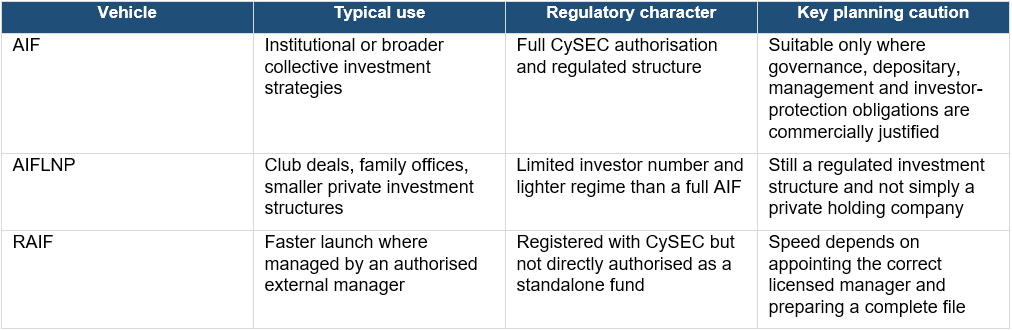
The RAIF regime is particularly useful where timing matters, but it should not be misunderstood. A RAIF does not avoid regulation; rather, regulation is channelled through the authorised external manager. This is attractive for private equity, real estate, credit, venture capital and other alternative strategies where a professional manager is in place and the investor base is suitable.
Fund structuring should begin with the investor base, investment strategy, target assets, leverage, liquidity, distribution policy, regulatory classification of investors, appointment of manager and depositary, and marketing jurisdictions. Tax treatment is important, but it should not drive the fund structure before regulatory suitability has been established.
Cyprus remains tax-relevant for international wealth and fund planning, but the analysis must reflect the current framework rather than older headline statements. From 1 January 2026, Cyprus corporate income tax is analysed by reference to the 15% rate under the 2026 reform materials. This makes it particularly important to model structures using current assumptions rather than outdated 12.5% references.
For Cyprus International Trusts, tax treatment depends on the residence and domicile position of the relevant parties, the source of income, the nature of assets and any distribution. A trust holding non-Cyprus assets for non-Cyprus beneficiaries may produce a different result from a trust holding Cyprus real estate, Cyprus shares or assets generating Cyprus-source income. The trust should therefore be reviewed asset by asset and beneficiary by beneficiary.
For funds, the analysis commonly includes corporate income tax, exemption or taxation of gains, Cyprus real estate exposure, withholding tax on distributions, investor-level tax treatment, VAT where relevant, and eligibility for incentives such as the notional interest deduction or intellectual property regime where the facts support them. Where the fund or holding structure interacts with low-tax jurisdictions, related-party transactions or financing flows, the analysis should also include transfer pricing, beneficial ownership and anti-avoidance considerations.
The practical message is that Cyprus is not merely a low-tax jurisdiction. It is an EU jurisdiction where tax outcomes depend on substance, records, governance, reporting and consistency between legal form and economic activity.
Residence planning is relevant because families and entrepreneurs often want the wealth structure, investment vehicle and personal relocation strategy to work together. Cyprus residence routes may include EU registration for EU/EEA/Swiss nationals, the Digital Nomad Visa, employment or company-of-foreign-interest routes, self-supported residence, Category F analysis and investor permanent residence under Regulation 6(2).
For high-net-worth families, Regulation 6(2) investor residence may provide a more stable immigration route, subject to the official investment and income requirements. For founders, employment or management through a Cyprus operating company may be more appropriate. For remote professionals, the Digital Nomad Visa may be relevant, but it does not of itself create a permanent residence or tax residence result. For EU nationals and family members, the EU residence-card framework must be analysed separately.
Tax residence remains a distinct question. Cyprus has the 183-day rule and the 60-day rule, but those rules must be applied independently from immigration status. The non-domiciled regime may be highly relevant for internationally mobile individuals, particularly where dividend and passive investment income is involved. However, non-dom treatment requires separate status analysis and evidence.
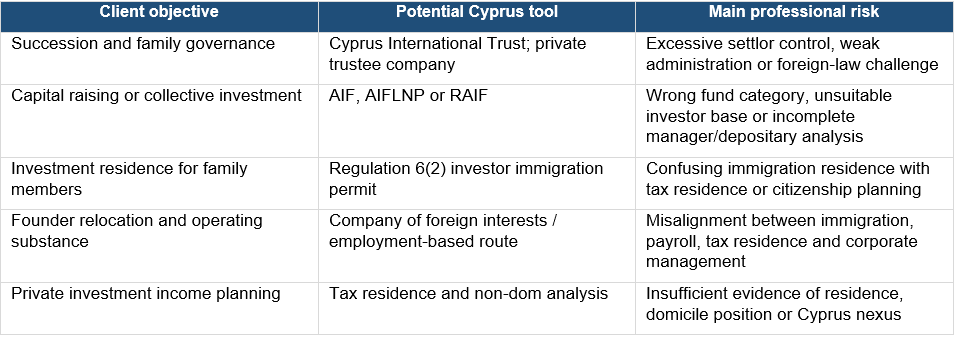
Cyprus offers a sophisticated platform for international wealth, investment management and relocation, but its strength lies in integration rather than in any single product. A trust may solve succession and governance issues; a fund may solve capital pooling and investment-management issues; a residence route may solve family mobility; and tax residence may solve personal tax planning. These outcomes should not be collapsed into one generic Cyprus solution.
For legal, tax and investment professionals, the correct method is to identify the client’s objective first and then select the appropriate legal instrument. The trust deed, fund documentation, company governance, immigration route, tax-residence file, accounting records and anti-money laundering evidence should all support the same factual narrative. Where that discipline is maintained, Cyprus can provide a robust EU platform for families, investors and business owners seeking long-term wealth planning and international mobility.
A trust is a fiduciary relationship in which trustees hold and administer assets for beneficiaries or permitted purposes. An investment fund pools capital under a defined investment policy and regulatory framework. Their governance, investor rights, taxation and compliance obligations are different.
A trust deed is not generally a public document, but confidentiality is not secrecy. Trustees and service providers must comply with beneficial-ownership, anti-money-laundering, sanctions, tax-reporting and lawful disclosure requirements, including applicable filings in the Cyprus Trusts Beneficial Ownership Register.
Cyprus law may permit reserved powers, but they must be drafted carefully. Excessive or inconsistent control can weaken the intended fiduciary separation and may affect tax, succession, asset-protection and recognition outcomes in relevant jurisdictions.
No. The licensing and regulatory analysis depends on the company’s activities, governance, ownership, jurisdictional connections and the services provided. A private trustee company should not be implemented on the assumption that its label alone creates an exemption.
They differ in authorisation route, eligible investors, management model, supervision, launch process and operating requirements. A RAIF is not directly authorised as a fund by CySEC and must be externally managed by an authorised manager; the correct category depends on the strategy, investor base and distribution plan.
No. Immigration status and tax residence are separate analyses. Cyprus tax residence generally depends on the applicable 183-day or 60-day conditions and the individual’s complete facts; residence and domicile status should also be distinguished.
No. A trust or fund interest does not by itself guarantee an immigration outcome. Each route has separate statutory conditions, evidence, source-of-funds checks and ongoing requirements. Cyprus citizenship should never be presented as an automatic investment consequence.

Immigration

Legal Business

Tax

Presentations

Tax Magazines

Guideline Article

Template

Checklist

eBook

Webinar

Our technical content is authored by ELTOMA's senior professionals with deep experience scos corporate services, legal, tax and compñance in international markets.
Speak with our experts about your cross-border
corporate and compliance requirements.
We will respond within one business day.

ELTOMA has been delivering international corporate, tax, and compliance solutions since 2004, helping businesses establish, operate, and grow across key global markets.

Receive updates with practical insights on international business, law, tax, accounting, and compliance.
Be the first to hear about our latest discounts and special offers!
Follow our Telegram channel for offshore industry news:
Want updates by e-mail?
Enter your email address below to subscribe to our newsletter!