Resources / Knowledge Base
Singapore Paid-Up Capital: Share Issues and ACRA Rules
Understand Singapore paid-up capital rules, share allotments, non-cash consideration, ACRA filings, licensing requirements and capital reductions.

Understand Singapore paid-up capital rules, share allotments, non-cash consideration, ACRA filings, licensing requirements and capital reductions.

Singapore generally permits a company type requiring share capital to start with at least S$1, but that threshold does not establish that the company is adequately funded or meets licensing requirements. Issued capital, paid-up capital, unpaid consideration, cash and shareholder loans are different concepts. A share issue also requires proper authority, supporting documents and the correct ACRA filing; for a private company, the allotment takes effect when the Electronic Register of Members is updated.
This guide explains the legal and practical treatment of Singapore share capital, non-cash subscriptions, funding evidence, investor rights, capital reductions and related tax and accounting issues. It is written for company directors, founders, investors and professional advisers. Sector-specific rules and transaction documents must be checked separately.
The nominal capital recorded at incorporation says little about whether a company can meet liabilities, satisfy licensing conditions, obtain banking facilities or accommodate investors without unfairly prejudicing existing members. Directors should consider the rights attached to shares, the consideration due and received, the constitution and their duties.
Singapore has operated a no-par-value share regime since 30 January 2006. Shares may be issued for cash or non-cash consideration and, in appropriate circumstances, without consideration. Not every subscription must be paid into a Singapore bank account; the company must nevertheless document the legal basis and evidence of payment or transfer. Paid-up capital does not show that an equivalent cash balance remains available.
Singapore companies limited by shares are principally governed by the Companies Act 1967 and their constitutions. The Act distinguishes the creation and allotment of shares, the alteration of share capital, transfers of existing shares, acquisitions by a company of its own shares, and formal capital reductions. These processes are not interchangeable, even when they yield a similar commercial balance-sheet outcome. Applicable securities, tax and sectoral licensing rules may impose separate constraints.
The Accounting and Corporate Regulatory Authority (ACRA), administering the Bizfile filing system and the electronic register of members (EROM) for private companies, publishes practical guidance; its webpages should be read with the statute rather than substituted for it. The 2026 ACRA guidance expressly distinguishes share capital, being the amount committed on issued shares, from paid-up capital, being the amount already paid. It also recognises non-cash consideration and multiple share currencies, subject to the applicable requirements.
The correct legal question is therefore not simply how much capital the company “has”, but what transaction produced the recorded figure, whether the contribution is legally due or completed, whether the correct corporate approvals were obtained, and whether the electronic statutory record has been updated. These questions are especially important where investors, directors and funders are situated outside Singapore.
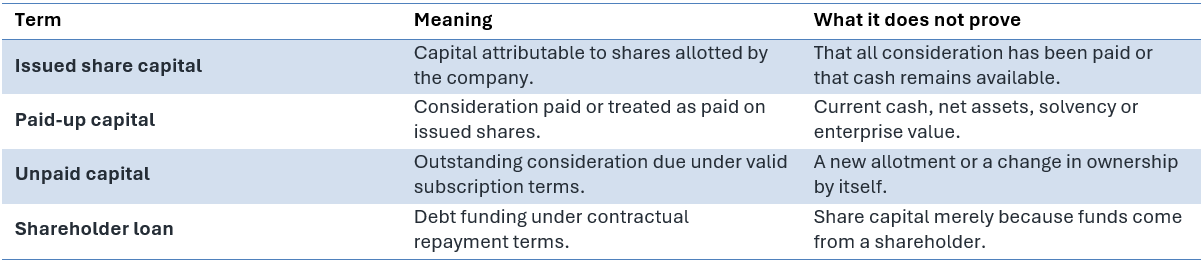
Issued capital represents capital attributable to shares already issued, whether or not their consideration has been paid in full. Paid-up capital records the amount paid or deemed paid on those shares. The balance, where a valid subscription remains outstanding, is unpaid capital. For example, if 100,000 shares are issued for aggregate consideration of S$100,000 but only S$40,000 is payable and paid immediately, the company records issued share capital of S$100,000 and paid-up share capital of S$40,000, with the remaining S$60,000 requiring appropriate accounting and contractual treatment. It would be inaccurate to describe the full S$100,000 as cash already received.
There is no continuing concept of authorised share capital imposing a fixed ceiling on future issues. Singapore abolished authorised capital and the nominal or par value of shares in 2006. The absence of par value does not eliminate the need for commercially defensible issue terms. Directors must still consider the company's constitution, existing shareholder agreements and the duties owed in exercising the power to allot.
Neither issued nor paid-up capital is synonymous with net assets, equity value, solvency or bank balance. Once contributed, funds may be spent in the ordinary course of business. Losses can reduce net assets below the amount of paid-up capital without changing the capital figure shown by ACRA. Likewise, a profitable company may accumulate significant retained earnings without having increased its issued capital.
ACRA states that a company type requiring share capital ordinarily needs at least S$1 in share capital and at least one issued share on incorporation. This is a general incorporation threshold, not a guarantee that a particular activity can be carried on with S$1. There is no universal requirement for foreign founders to inject a separate, higher amount merely because they are not Singapore residents.
The adequacy of initial funding depends on the contemplated business model. A service company requiring modest overheads may use a small subscribed amount coupled with documented shareholder advances. A business leasing premises, importing inventory or employing a substantial workforce needs a working-capital budget reflecting the timing of rent, deposits, payroll, supplier costs and the likely delay before customers pay. Regulators and counterparties may examine the wider substance of the enterprise rather than merely the amount on ACRA's business profile.
The board should prepare a realistic cash-flow forecast before approving the capital structure. The sensible question is whether the company has sufficient accessible resources, or enforceable arrangements for additional funding, to discharge obligations as they fall due. Share capital is an important disclosure and governance mechanism, but it is not itself a substitute for liquidity management or regulatory capital.
Some regulated activities require minimum capital or other financial resources exceeding the general incorporation threshold. In payment services, the Monetary Authority of Singapore currently identifies a base-capital requirement of S$250,000 for a major payment institution licence, together with the need for an appropriate capital buffer. Whether a proposed entity qualifies for a particular licence and what capital calculation applies requires assessment under the relevant licensing framework; it is not resolved by merely entering S$250,000 as paid-up capital in Bizfile.
Requirements for insurance, financial advisory, travel or other regulated activities are determined by their own legal and licensing regimes and may change. The older ELTOMA guidance listed fixed figures for various industries without distinguishing their precise licence categories or operative conditions. Repeating them as universal 2026 thresholds would be unsafe. Licensing capital, paid-up share capital, net assets, security deposits and regulatory base capital may be different measures.
A compliance review should therefore precede incorporation where the proposed activity is regulated. The review should identify the licence, permitted activities, qualifying capital instruments, regulatory deductions, safeguarding obligations, approval stages and whether funds must remain unencumbered. Corporate-law compliance is necessary but cannot, by itself, establish licensing eligibility.
ACRA identifies four broad methods of payment for issued shares: entirely in cash; entirely otherwise than in cash; without consideration, as in certain bonus issues; or partially in cash and otherwise than in cash. The older proposition that every paid-up capital subscription must be transferred in money to the company's corporate bank account is therefore incorrect. Property, rights or services may constitute consideration in a properly structured transaction, although valuation, completion and accounting questions must be addressed.
A founder may transfer specified equipment or intellectual property under an asset-contribution agreement; a creditor might agree, subject to the proper approvals and documentation, to convert a genuine debt into equity. These structures call for evidence that the company has received the bargained-for benefit and that any necessary assignment, delivery or registration has been completed. An internally asserted valuation is not necessarily conclusive, particularly where related parties are involved.
Where services are proposed as consideration, advisers should distinguish services already rendered, contractual commitments and future contingent performance. A share described as “fully paid” when the relevant consideration has not in substance been provided can create accounting, directors' duty and misrepresentation risks. Independent valuation, board minutes, properly executed transfer instruments and advice on GST or other taxes may be appropriate depending on the asset and circumstances.
Incorporation and opening a bank account are separate processes. ACRA states that a company may arrange a corporate bank account after registration; it does not require every incorporation subscription to have been deposited into a Singapore bank account before the company legally exists. Nevertheless, a company must maintain a reliable record of the contractual obligation to contribute, the actual means and timing of settlement, and the receipt or transfer of value. The documentation should correspond to the capital information filed.
For foreign-owned entities, cross-border transfers raise practical issues concerning sanctions screening, beneficial ownership, source of wealth, source of funds and the banking institution's risk appetite. A bank's refusal to accept funds, or a pending account-opening application, should not be concealed through an inaccurate declaration that capital has been paid. If the shares remain partly paid, the accounting and filings should reflect that position until payment takes place.
Payment through a director's personal account, a third party or a group treasury vehicle demands particular scrutiny: advisers must establish who discharged the subscription obligation, whose money was used, whether a shareholder loan arose, and whether the transaction is properly attributed to the company. Maintaining the payment narrative and supporting bank records is generally more valuable than an unsupported assertion in a capital confirmation letter.
Section 161(1) of the Companies Act provides that directors must not exercise the company's power to issue shares without prior approval of the company in general meeting, notwithstanding any provision in the constitution. Approval may be specific or general, subject to statutory limits concerning its duration and revocation. An attractive term sheet or a directors' resolution alone does not dispense with the need to test section 161.
Before an allotment, the corporate secretary should review the constitution, the latest general-meeting authority, shareholder agreements, class rights and any pre-emption or consent arrangements. The board should then consider the proposed consideration, share class, allocation, dilution, conflicts and commercial purpose. The relevant resolutions must be properly drafted and the statutory filing completed in the required sequence.
A frequent error is to treat a proposed subscription as legally effective upon remittance of money or signing of a share certificate. For a private company, the subsequent EROM update is integral to effectiveness. Until the required filing has been made and processed, the investment documentation should expressly address the status of funds received, conditions precedent and the consequences if the allotment is delayed or rejected.
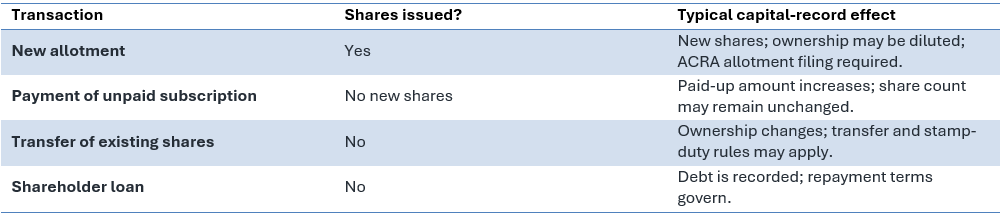
Under section 63(2), an allotment by a private company, other than a deemed allotment to subscribers to the constitution, does not take effect until the Registrar updates the company's EROM pursuant to section 196A(5). ACRA's 2026 guidance reiterates that the allotment ordinarily takes effect on the filing date once the register is updated and cannot be backdated. This is a legally consequential distinction, not a mere administrative preference.
The return of allotment contains the number and class of new shares, the amount paid or deemed paid and unpaid, the holders and relevant identification details. Non-cash issues may require supporting agreements or orders. ACRA indicates that the return-of-allotment service is free and generally processed immediately, but a complete document package, valid shareholder approval and accurate existing share records remain essential.
Public companies are subject to a different procedural framework, including the section 63A requirement to lodge a return of allotment within 14 days of allotment. The private-company EROM rule must not be casually transposed to public companies. Transaction timetables, especially for completion accounts and investor voting rights, should explicitly identify the legal effective date.
A shareholder may settle unpaid consideration on shares already allotted. That payment increases the amount recorded as paid-up on those shares but does not necessarily increase the number of shares or the total amount originally subscribed. ACRA distinguishes this event from a new allotment and prescribes a notice to update paid-up share capital. The 2026 ACRA overview gives the straightforward example of an investor paying an outstanding S$5,000 on shares earlier issued partly paid.
A new issue creates additional shares and may change voting percentages, entitlement to dividends and control. A payment of an existing call, by contrast, ordinarily discharges an existing obligation and may leave percentage holdings unchanged. Directors and accountants should avoid incorrectly submitting an allotment when the actual transaction is payment on shares already issued; equally, a purported “top-up” cannot create new ownership rights without following the allotment process.
Where a shareholder advances money without intending to subscribe for additional shares or discharge an outstanding subscription, the amount may be a loan, advance, capital contribution of a different character or another liability or equity item, depending on enforceable terms and the applicable accounting standards. Labels used in banking narratives do not determine the legal character of the contribution.
Ordinary, preference, redeemable preference and convertible preference shares can be used to allocate economic return and control differently. Shares may be issued in more than one currency, subject to the constitution and regulatory requirements. ACRA expressly acknowledges multiple share currencies; accordingly, a company's apparent capital cannot always be reduced to a single uncomplicated Singapore-dollar figure without a coherent reporting basis.
Preference rights should be drafted with particular care: priorities in distributions and winding up, conversion ratios, redemption conditions, dividend rights, class voting and reserved matters determine commercial value. A share class described as “preference” does not automatically carry a particular package of rights. The constitution, terms of issue and any shareholder agreement should be read together.
Boards should also understand the distinction between changing share capital and changing its numerical representation. A share split or consolidation may alter the number of shares without changing the aggregate capital amount. A conversion of shares or reclassification may affect rights and consent requirements. ACRA's separate alteration and conversion services reflect the need to identify the actual legal transaction rather than merely the result desired in the register.
An equity raising may be commercially necessary while also diluting existing shareholders. That outcome is not automatically unlawful, but directors must exercise the allotment power for proper corporate purposes, comply with section 161 and honour contractual commitments. The price, allocation and timing may be scrutinised where controlling shareholders receive a disproportionate benefit. An issue nominally intended to improve liquidity may be oppressive if its real effect is to transfer control unfairly.
The High Court decision in Lim Anthony v Gao Wenxi [2020] SGHC 67 provides a direct illustration. A unilateral issue of additional shares dramatically reduced the claimant's holding contrary to an agreement requiring mutual consent for new issues and increases in paid-up capital. The court treated the dilution as commercially unfair under section 216. The decision is not authority that all dilution is prohibited; rather, it underscores the significance of legitimate expectations and the parties' agreed governance arrangements.
The appellate authorities on section 216, including Sakae Holdings Ltd v Gryphon Real Estate Investment Corp Pte Ltd [2018] SGCA 33, characterise the central concern as commercial unfairness. Directors planning a related-party placing should document independent valuation, alternatives considered, conflicts and the reasons the terms are fair to the company. Where disputes are anticipated, advance judicial or specialist advice may prevent filings that are difficult to reverse.
A larger paid-up capital figure can be commercially useful. It may demonstrate that founders have accepted a greater amount of equity risk, support a tender qualification, satisfy a contractual threshold or form one element of a bank's assessment. In certain circumstances it may reduce immediate reliance on shareholder borrowing. None of these outcomes is automatic. Creditworthiness depends on the company's liquidity, operating cash flows, assets, liabilities, security and financial conduct.
Paid-up capital is not a fund ring-fenced for creditors. If the company receives S$500,000 for shares and then spends S$400,000 on legitimate operating costs, its registered paid-up capital does not fall to S$100,000 merely because the bank balance has declined. Conversely, paid-up capital may remain substantial while the company is insolvent. It is therefore inaccurate to suggest that lenders can always recover their exposure directly from “paid-up capital” on insolvency.
ACRA's business-profile guidance encourages users to consider paid-up capital among other indicators when assessing risk. A mature diligence exercise requires financial statements, cash-flow forecasts, bank confirmations, contingent liabilities, related-party balances and the extent to which nominally contributed assets are realisable. Corporate capital is one component of financial substance, not a substitute for it.
ACRA's share-capital guide states that companies with paid-up share capital of S$500,000 or more automatically become members of the Singapore Business Federation (SBF). This rule can create an administrative and cost consideration when a company plans a capital increase; advisers should confirm the current statutory eligibility and subscription arrangements before treating a threshold as a reason to change capital.
A business should not inflate paid-up capital merely to obtain a perceived badge of credibility, nor reduce capital merely to attempt to avoid a commercial obligation without considering the legal consequences. Membership may have genuine benefits through business networks, advocacy and programmes, but its significance will depend on the enterprise. The correct decision takes account of planned funding, licensing, contractual commitments and the cost of later capital transactions.
Where a company has shares in several currencies, or has made recent filings, its advisers should verify how the relevant authority determines the membership threshold and at what point the new information becomes operative. Capital strategy should not be driven by an isolated internet statement taken out of its statutory and administrative context.
Equity and shareholder debt meet different commercial needs. Subscribed share capital ordinarily exposes the investor to residual business risk: shareholders rank behind creditors and generally have no right to demand repayment simply because a project has ended. Properly documented loans establish contractual repayment rights, potentially with interest and security, subject to insolvency, fraudulent preference and other applicable restrictions. An investor wishing to preserve repayment flexibility should analyse the two instruments before transferring funds.
Intragroup funding requires particular care. A parent may prefer loan financing to preserve a simple share structure, but the Singapore subsidiary must be able to demonstrate the legal basis for the liability and the commercial terms. Interest deductions, withholding tax, transfer pricing and thin-capitalisation-type economic concerns may warrant separate tax analysis. Singapore does not operate a universal statutory rule converting every shareholder advance into share capital.
The company should keep signed subscription agreements, shareholder-loan agreements and clear accounting records. Where funds are later converted into equity, the conversion is a fresh legal transaction: evidence of the debt, the agreed discharge, valuation, approvals and EROM filing will be required. Neither a ledger journal nor a shareholder email alone necessarily completes the relevant corporate acts.
Share capital appears within equity for accounting purposes, subject to the applicable financial reporting framework and the actual substance of the instrument. The classification of complex redeemable or preference instruments may not be straightforward: contractual obligations to deliver cash can make accounting classification different from the legal label attached to the share. The company's accounting policy and the Singapore Financial Reporting Standards framework must be considered.
Capital receipts ordinarily are not operating revenue simply because cash is received. A subscription should be reconciled to the share register, issue documents and bank or asset-transfer evidence. Unpaid capital and amounts due from shareholders require a careful analysis of enforceability, presentation and impairment. Transactions between shareholders and the entity should not be recorded as sales without a substantive commercial basis.
A statutory capital figure can survive losses, while dividends depend upon separate rules governing profits and distributions. Directors should not assume that the availability of cash, the receipt of a capital subscription or an accounting reserve itself authorises a dividend. Improper distributions may expose decision-makers to recovery actions or other liability. Auditors and corporate secretaries should reconcile proposed distributions with the underlying equity movements and statutory requirements.
A reduction of share capital is not an ordinary payment of money back to an investor. Sections 78B–78G of the Companies Act regulate reductions through the shareholders' special-resolution route or the court route, with publicity and creditor protections. For a private company using the resolution route, section 78B ordinarily requires the relevant solvency conditions where a reduction involves an asset distribution or the release of a liability owed to the company. A reduction that makes no such distribution or release may engage the statutory exception to the solvency requirement; the precise transaction must be analysed.
ACRA's guidance updated in November 2026 provides the procedural outline: special resolution, required statutory filing, publication, a six-week period during which creditors may apply to object, and an effectiveness filing within the prescribed window. Where applicable, all directors must make the statutory solvency statement. The company's capital does not simply reduce when members resolve to do so; effectiveness is tied to completion of the prescribed process.
The six-week objection period gives creditors an opportunity to challenge a transaction that could jeopardise recovery. The court-approved route has different filing and timing requirements. Insolvent or near-insolvent companies require particular care: a balance-sheet reorganisation cannot be used casually to extract value from creditors. Practitioners should separately assess distributions, related-party repayments and directors' duties when the business faces financial distress.
A company wishing to return investment to one or more shareholders may consider share buy-backs, redemption of redeemable preference shares, a formal reduction of capital or, in appropriate circumstances, dividends or liquidation distributions. These mechanisms differ in their statutory conditions, accounting consequences, creditors' protections and tax treatment. They are not interchangeable methods of “withdrawing paid-up capital”.
The Companies Act contains specific provisions for acquisitions by a company of its own shares and their financing, as well as rules for preference-share redemption. The statutory capital-reduction division expressly distinguishes some lawful buy-backs and redemptions from the general reduction procedure. The precise route depends on the company's constitutional powers, share class, solvency position, existing shareholder arrangements and proposed funding source.
At dissolution, shareholders do not receive an automatic refund of the amounts originally subscribed. The liquidator realises assets and applies them in accordance with the insolvency priority rules; shareholders generally participate only in any remaining surplus. A company that received substantial equity and incurred greater losses may have no capital available for repayment. The historical nominal contribution is not a deposit held on trust for its subscriber.
An allotment of new shares in return for equity consideration should not be confused with a sale of existing shares or the receipt of trading income. The tax analysis is transaction-specific. Genuine equity funding will ordinarily be considered a capital receipt rather than operating turnover, but non-cash asset transfers, debt releases, employee share arrangements and transactions with connected persons can raise separate income tax, GST or valuation issues. A statement that all “capital increases” are tax-free would be too broad.
IRAS explains that share duty generally concerns dutiable instruments transferring existing shares; the standard share-transfer duty is 0.2% of the higher of consideration or value, subject to the applicable calculations and exceptions. An ordinary primary issue of shares should not be equated with a secondary transfer that gives rise to a dutiable instrument. However, an investment involving landholding entities, trust arrangements or a composite reorganisation may require further analysis, including additional conveyance duties.
The company and investor should establish whether the consideration is cash or property, identify any deemed disposal, and reconcile the contractual economics with the tax filings. Where a capital transaction is connected with employee remuneration or consultancy services, the absence of cash does not eliminate the possibility of taxable benefits or other tax consequences.
Capital structuring is now closely connected to corporate service provider due diligence and transparency of ultimate ownership. Issuing shares through a nominee or intermediary does not remove obligations relating to the Register of Registrable Controllers and the applicable nominee-director and nominee-shareholder registers. An investor subscribing in the name of an overseas company may be required to disclose the ultimate individual controllers and provide an ownership chain.
Banks, CSPs and professional advisers may request subscription agreements, board approvals, the source of contributed cash or non-cash assets, details of connected parties and the business rationale for a capital change. These enquiries are distinct from ACRA's mechanics of allotment. A perfectly valid issue of shares may still be delayed by an incomplete source-of-funds review or missing customer due diligence material.
Particularly in cross-border structures, advisers should assess the shareholder's home-jurisdiction exchange controls, sanctions exposure and tax consequences. A Singapore incorporation certificate or a statement of paid-up capital cannot legalise a funding transaction that breaches another applicable regulatory regime. These considerations should be brought into the timetable before signatures, transfers and filings are coordinated.
Example A — small start-up: Two founders incorporate a private company with one hundred ordinary shares issued for S$100 and fully paid. The company later receives S$30,000 from one founder. Unless the documentation establishes a new share subscription or payment due on existing shares, the S$30,000 should not automatically be reported as additional paid-up share capital. A shareholder loan may be appropriate, with different creditor and shareholder consequences.
Example B — staged subscription: An investor subscribes for 50,000 shares for S$50,000, paying S$20,000 initially under properly agreed partly-paid terms. When the investor later pays S$30,000, the company generally updates the paid-up amount on the existing shares rather than issuing another 30,000 shares. The secretary verifies the original issue terms, payment evidence and the relevant ACRA update.
Example C — equipment contribution: A shareholder transfers production machinery to the company in exchange for new shares. There is no inherent legal requirement to send the equivalent cash value through a corporate bank account, but the machinery must be validly transferred and the exchange must be supportable. The board records valuation evidence and any required related-party declarations.
Example D — investor round: A majority shareholder proposes a below-market issue of shares entirely to an associated entity, severely diluting a minority investor. The directors cannot rely on a routine capital-filing form to establish the transaction's fairness. Section 161 approval, shareholders' contractual rights and section 216 oppression risk all require attention.
Example E — surplus capital: A profitable company wishes to return S$300,000 of paid-up capital to members. A simple bank payment is not a lawful substitute for capital-maintenance compliance. Directors consider whether a formal reduction, permissible buy-back or another legally available transaction best matches the intended outcome, and carry out any required creditor safeguards.
A robust capital transaction begins with a written instruction identifying whether the investor is subscribing for new shares, paying outstanding consideration, transferring existing shares, advancing debt or participating in a return of capital. This classification determines the approvals, filings, supporting evidence and effective date. The corporate secretary should reconcile the capital ledger to the EROM, constitution, shareholder register information and financial statements before filing.
The board should document commercial rationale, pricing, conflicts, use of proceeds and the impact on existing members. For non-cash consideration, independent valuation or evidence of rights transferred may be indispensable. The accountant should confirm the journal entries, currency, paid and unpaid components and consistency with the signed documents. The tax adviser should examine any dutiable instrument, employee-related component, connected-party transaction or cross-border tax exposure.
After completion, the company should obtain current ACRA evidence, update its cap table, deliver contractual notices, retain the resolutions and payment records, and reassess beneficial ownership disclosures. Where more than one adviser is involved, the client should receive a completion checklist identifying responsibility for each step. Filing accuracy and contemporaneous documentary support are essential because later correction may require formal procedures and, in a contentious case, court involvement.
Singapore's low general incorporation capital threshold offers considerable flexibility, but it must not be mistaken for a permissive regime governing every capital transaction. The country's corporate law differentiates issued and paid-up capital, allows properly documented non-cash subscriptions, imposes shareholder approval requirements on directors' issue of shares, and gives real legal significance to EROM updates for private-company allotments.
Capital structuring should be treated as a legal, accounting, governance and financial-risk exercise. A defensible arrangement is one whose contributions can be proved, whose rights are properly documented, whose approvals and filings are accurate, and whose financial implications are understood by investors and creditors. The 2023 account of paid-up capital should therefore be replaced rather than lightly amended: its cash-only statement and simplified description of capital adjustments do not adequately reflect the governing framework.
Issued share capital is the amount attributed to shares that have been allotted, whether or not the full consideration has been paid. Paid-up capital is the amount paid or treated as paid on those shares. Any unpaid balance must be supported by the subscription terms and recorded accurately. Neither figure represents the company’s current cash balance or net asset value.
Generally, a company type that requires share capital needs at least S$1 in share capital to start, according to ACRA. This is an incorporation threshold, not a funding recommendation. The company must still meet any sector-specific capital and licensing requirements, and its directors should consider the cash needed to meet liabilities and operate the business.
Not necessarily. ACRA recognises non-cash allotments, and the legal analysis turns on the subscription terms, the consideration actually transferred and the applicable filing requirements. The company should retain evidence of the contribution and its value. A bank transfer description alone does not establish that a payment is share capital rather than a loan or other receipt.
No. A later payment of outstanding consideration on shares already allotted may increase the paid-up amount without changing the number of shares or ownership percentages. A new allotment is a separate transaction and may dilute existing members. The company should identify which transaction occurred before updating its records or filing with ACRA.
For a private company, ACRA states that the allotment takes effect on the date the return of allotment is filed and the Electronic Register of Members is updated. A shareholder resolution, payment or share certificate should not be treated alone as completing the statutory process. Directors’ authority under section 161 and the constitution must also be checked.
MAS guidance states a base-capital requirement of S$250,000 for a major payment institution (MPI), with an appropriate capital buffer. An MPI must also meet a separate security requirement before commencing business. The relevant requirements depend on the licence and payment-service profile; these regulatory measures are not interchangeable with the general S$1 incorporation threshold.
Stamp duty generally applies to transfers of existing shares, not simply because a company allots new shares. IRAS states that share-transfer duty is 0.2% of the purchase price or value of the shares transferred, whichever is higher, subject to the applicable rules and exemptions. Property-holding companies and restructuring transactions require separate review.
A payment alone does not lawfully reduce share capital. The company must use a permitted mechanism, such as a statutory capital reduction, share buy-back, redemption where available, or a distribution from profits where the legal conditions are met. Each route has distinct approvals, solvency, creditor-protection, accounting and filing consequences.

Immigration

Legal Business

Tax

Presentations

Tax Magazines

Guideline Article

Template

Checklist

eBook

Webinar

Our technical content is authored by ELTOMA's senior professionals with deep experience scos corporate services, legal, tax and compñance in international markets.
Speak with our experts about your cross-border
corporate and compliance requirements.
We will respond within one business day.