

Eltoma Corporate Services — Authorised Corporate Services Provider
Articles are provided for general informational purposes by an authorised corporate services provider and do not constitute legal advice.

The European Commission has formally confirmed its backing for Cyprus’s accession to the Schengen Area. For legal practitioners and corporate advisers, this carries significance beyond the political: it indicates the process is being treated as a concrete near-term objective within the European freedom-of-movement agenda, rather than a long-range aspiration.
The Commission’s endorsement also serves as a credibility signal for capital markets and investors evaluating Cyprus Schengen accession as a factor in their jurisdictional decision-making. It reflects a Commission assessment that Cyprus has made meaningful progress toward meeting the technical and legal criteria for membership.
Formal admission to the Schengen zone Cyprus requires unanimous approval by current member states, preceded by a Schengen Evaluation covering: external border management; integration with SIS II (the Schengen Information System); conformity with the common Schengen visa policy; and law enforcement and judicial cooperation. Commission support does not bypass this process.
Cyprus is a full EU member state but sits outside the Schengen Area. This means standard border controls remain in place at Cypriot ports of entry, and Cypriot residency permits do not automatically confer free movement within Schengen territory. Cyprus Schengen accession would change this materially.
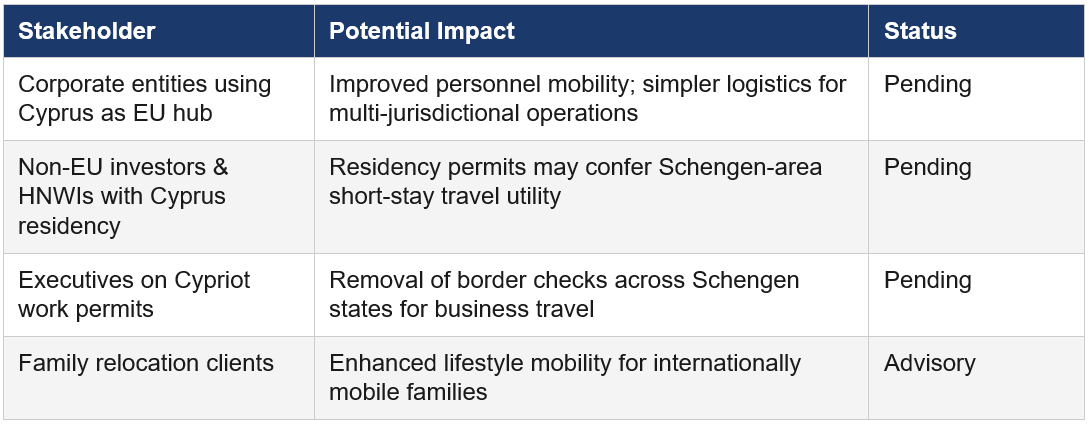
Post-accession, executives, directors, and employees based or registered in Cyprus would be able to move freely across 27+ Schengen states without passport checks. For companies using Cyprus as a European corporate hub, this removes a current operational friction point for personnel travelling to continental EU offices or client meetings.
Cyprus EU residency permits — including those issued under long-term residency, investment, or employment categories — would gain material travel utility within the Schengen zone. This substantially increases the attractiveness of Cyprus-based residency for internationally mobile individuals and families.
The most complex unresolved issue in Cyprus’s Schengen accession path is the Green Line — the UN-monitored buffer zone separating the government-controlled Republic of Cyprus from the northern area not under the Republic’s control. This creates a unique external border challenge with no direct precedent in any other Schengen accession process.
Schengen membership requires that all external borders satisfy the EU Schengen Border Code. Crossing points along the Green Line currently operate under a distinct legal framework that does not conform to standard Schengen external border procedures. Technical solutions for biometric data exchange, SIS II integration, and surveillance standards at these points remain an active condition of accession.
The table below summarises anticipated impacts by stakeholder group once Cyprus Schengen accession is formalised:
Under the current regime, time spent in Cyprus does not count against the Schengen 90/180-day allowance — a planning consideration used by some non-EEA clients to structure their EU presence. Upon accession, days in Cyprus would be included in the Schengen count. Clients with structures built around this distinction should initiate a review now.
Cyprus’s national visa — currently a separate instrument from the Schengen visa — would be replaced by the standard Schengen short-stay visa. This harmonises entry rights but also subjects Cyprus to Schengen-wide visa issuance rules and reciprocity obligations. For clients planning Cyprus-based relocation or regular entry from third countries, this changes the visa pathway and should be assessed as part of any immigration or tax residency plan.
The European Commission’s support strengthens the long-term case for Cyprus as a fully integrated EU jurisdiction. For companies structuring international operations, asset holding, or IP management through a Cyprus offshore company or resident entity, Schengen accession would add a further layer of operational and lifestyle utility to an already favourable tax and legal environment.
That said, current rules apply. Schengen accession remains subject to evaluation and unanimous member-state approval. Any structural or immigration decisions should be based on the existing legal framework, with accession treated as a potential future enhancement — not a current right.
We continue to monitor the legislative and regulatory process and will publish updated guidance as material developments occur. Clients wishing to assess the impact on their existing Cyprus structure or to explore relocation to Cyprus are encouraged to contact us for a confidential review.
No. Cyprus is a full EU member state but is not currently part of the Schengen Area. Standard border controls apply at Cypriot entry points, and Cypriot residency permits do not automatically grant free movement within Schengen territory.
No official accession date has been set. The European Commission has confirmed its support, but formal accession requires a Schengen Evaluation and unanimous approval by existing member states. The Green Line border situation remains an outstanding technical condition.
Upon accession, Cypriot long-term residency permits are expected to qualify for Schengen-area short-stay travel. This would significantly increase the practical utility of Cyprus EU residency for internationally mobile individuals. The 90/180-day Schengen rule would also apply to time spent in Cyprus.
Not directly. Incorporation or registration of a Cyprus offshore company or resident entity does not itself confer Schengen travel rights. Travel rights are linked to individual nationality, visa status, and residency permits. Post-accession, certain Cypriot residence-based permits may facilitate Schengen travel — but this should be assessed case by case with qualified legal advice.
Articles are provided for general informational purposes by an authorised corporate services provider and do not constitute legal advice.

Receive updates with practical insights on international business, law, tax, accounting, and compliance.
Be the first to hear about our latest discounts and special offers!
Follow our Telegram channel for offshore industry news:
Want updates by e-mail?
Enter your email address below to subscribe to our newsletter!