

Eltoma Corporate Services — Authorised Corporate Services Provider
Articles are provided for general informational purposes by an authorised corporate services provider and do not constitute legal advice.

A Singapore company’s annual return is not merely an online form. It is the annual corporate registry filing with the Accounting and Corporate Regulatory Authority (ACRA) and should be supported by accurate accounting records, a correct financial statement filing assessment, any required XBRL preparation and separate tax filings with the Inland Revenue Authority of Singapore (IRAS). For foreign-owned companies, the practical issue is not only whether the annual return can be submitted, but whether the company’s statutory, accounting, tax and banking records can be reconciled.
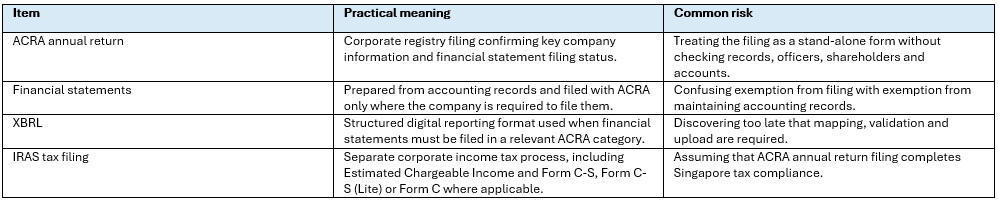
ACRA states that all live Singapore companies must file an annual return each year. This applies even where the company is inactive or dormant, and even where IRAS has granted a tax waiver. The filing confirms key information such as the company name, registration number, company type, business activities, registered office address, directors, company secretary, members, share information and financial statements where required.
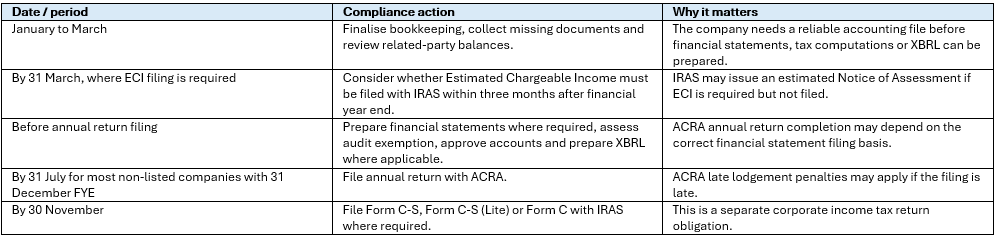
For most non-listed private companies, the annual return deadline is within seven months after the financial year end. Listed companies generally have a shorter five-month deadline. Companies with share capital and an overseas branch register may have different deadlines. The company should therefore monitor its financial year end from incorporation and confirm the exact ACRA deadline before the filing season.
A common misunderstanding is that the ACRA annual return is the company’s tax return. It is not. The annual return is a corporate registry filing. Corporate income tax filings are made separately to IRAS and require a tax analysis of income, deductions, exemptions, taxable profits and supporting computations.
The distinction matters because the timelines and legal purposes differ. A company may file its annual return with ACRA and still have to file Estimated Chargeable Income, unless exempted, and its annual corporate income tax return with IRAS. Conversely, a tax waiver or dormant tax treatment does not automatically remove ACRA annual return obligations.
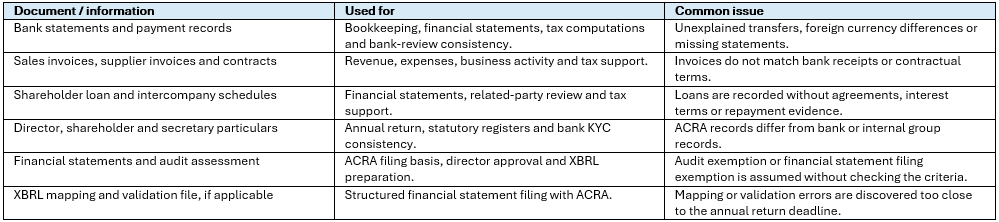
Annual return preparation should begin with the company’s accounting records, not the Bizfile form. A foreign-owned Singapore company should maintain records sufficient to explain its transactions and financial position. These usually include bank statements, sales invoices, supplier invoices, service agreements, loan documents, payroll records, director and shareholder transactions, intercompany balances, foreign exchange records and support for expenses.
These records are the foundation for financial statements, audit assessment, XBRL preparation and tax filing. Missing invoices, unexplained bank movements, undocumented related-party transactions and incomplete shareholder loan records may delay every part of the annual compliance cycle. A company that leaves bookkeeping until the annual return deadline often discovers that the filing problem is only a symptom of a larger record-keeping problem.
ACRA’s financial statement guidance distinguishes between preparing financial statements and filing financial statements. Singapore-incorporated companies generally must prepare financial statements except dormant relevant companies, and must file financial statements with ACRA unless exempted. Financial statements filed as part of the annual return are available for public purchase.
This distinction is important for business owners. A company may be exempt from filing financial statements with ACRA but still need proper accounts for directors, shareholders, banks, tax filings, audit review, due diligence or internal management. Exemption from filing should not be treated as permission to ignore bookkeeping.
Many small foreign-owned Singapore companies are exempt private companies. A solvent exempt private company may not need to file financial statements with ACRA if the applicable conditions are satisfied. ACRA’s guidance also indicates that the company must make an online declaration of solvency when filing its annual return.
Dormant relevant companies require separate review. A dormant relevant company may be exempt from preparing and filing financial statements if the statutory conditions are met, including the relevant dormancy and asset conditions. Dormant status should not be assumed merely because the company has no revenue. Assets, liabilities, bank accounts, intercompany balances, shareholder loans and other corporate obligations may still require analysis.
Audit should be considered as part of the annual compliance workflow, but it is not the same as annual return filing. The audit position may depend on the company’s revenue, assets, number of employees, group structure, shareholder requirements, banking obligations and contractual requirements. Even where audit exemption applies, directors should ensure that the accounts are properly prepared, reviewed and approved.
Director approval is not a formality. Financial statements represent the company’s financial position and performance. Directors should therefore understand related-party balances, loans, foreign currency movements, transactions with overseas counterparties and any significant accounting judgements before approving the accounts.
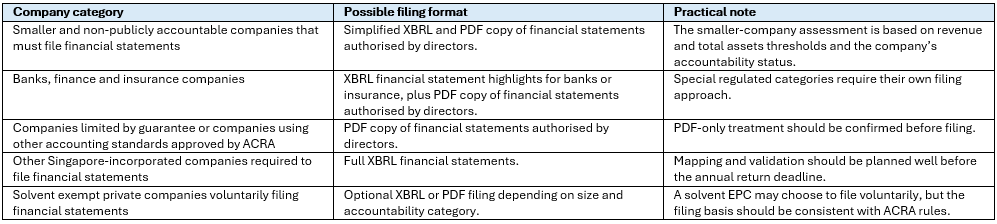
XBRL is a digital format for filing financial statements with ACRA. Where a company must file financial statements, it may need to file them in XBRL format depending on the applicable filing category. XBRL preparation is not a simple conversion of a PDF. Financial statement line items must be mapped to the relevant ACRA taxonomy, figures must be internally consistent and the file must pass validation checks before it can be used in the annual return.
ACRA’s 2026 XBRL materials apply to filing requirements from 25 February 2026 onwards, including the ACRA Taxonomy 2026. Companies can prepare and file XBRL financial statements using the BizFinx Preparation Tool, approved accounting software or a corporate service provider. After XBRL data is uploaded to the BizFinx server, the annual return should be filed within the period during which the uploaded XBRL file remains available.
The following example illustrates why the annual return should be treated as part of a broader compliance calendar rather than a single filing event.
Eltoma Global can assist foreign-owned Singapore companies with annual compliance coordination, including annual return preparation, accounting-record requests, financial statement coordination, audit and XBRL assessment, corporate record review and coordination with tax filing workflows. The service should be scoped to the company’s facts, financial year end, filing category and regulatory position.
For most non-listed Singapore companies, the annual return deadline is within seven months after the financial year end. The exact deadline should be checked against the company type and financial year end because listed companies and certain companies with overseas branch registers have different timelines.
No. The ACRA annual return is a corporate registry filing. IRAS tax filings are separate and deal with taxable income, tax computation, deductions and corporate income tax obligations. The two processes are different, although both normally depend on accurate accounting records.
Yes, a live Singapore company generally still needs to file an annual return even if it is inactive or dormant. Dormant status may affect financial statement preparation, audit and tax requirements, but it should not be assumed to remove all annual compliance obligations.
Singapore-incorporated companies generally prepare financial statements unless a statutory exemption applies, and file them with ACRA unless exempted. Solvent exempt private companies and dormant relevant companies may have reduced filing requirements if statutory conditions are met.
XBRL is a structured digital format for filing financial statement information with ACRA. Where financial statements must be filed, the company may need to use Full XBRL, Simplified XBRL, XBRL financial statement highlights or a permitted PDF-only filing format depending on its category.
The company should prepare accounting records, bank statements, invoices, contracts, loan documents, payroll records, shareholder and director information, financial statements where required, audit assessment, XBRL mapping where applicable and separate tax-filing data for IRAS.
It should not. Late bookkeeping often exposes missing invoices, unexplained bank movements, incomplete shareholder loan records and related-party issues. These problems may delay financial statements, audit assessment, XBRL preparation, annual return filing and tax compliance.
Articles are provided for general informational purposes by an authorised corporate services provider and do not constitute legal advice.

Receive updates with practical insights on international business, law, tax, accounting, and compliance.
Be the first to hear about our latest discounts and special offers!
Follow our Telegram channel for offshore industry news:
Want updates by e-mail?
Enter your email address below to subscribe to our newsletter!