

Eltoma Corporate Services — Authorised Corporate Services Provider
Articles are provided for general informational purposes by an authorised corporate services provider and do not constitute legal advice.

Cyprus residence planning in 2026 should start by separating three questions: whether the client may lawfully reside in Cyprus, whether the client is Cyprus tax resident, and whether the client may benefit from Cyprus non-domiciled treatment. A residence permit, Yellow Slip, Digital Nomad Visa, employment permit or investor immigration permit does not automatically create Cyprus tax residence. The immigration file and tax file should be analysed separately and then aligned with evidence such as travel records, accommodation, employment, company substance, payroll and accounting documentation.
Cyprus remains an important EU jurisdiction for private clients, business owners, entrepreneurs, investors and internationally mobile professionals. Its practical attraction is that residence planning may be combined with tax residence, company formation, business substance, banking, accounting and family relocation within one coherent framework.
For third-country nationals, the first legal distinction is essential. Immigration residence and tax residence are separate concepts. A person may have permission to live in Cyprus without being Cyprus tax resident. Conversely, an individual may become Cyprus tax resident only if the Cyprus tax rules are satisfied and, where another country also asserts residence, the relevant double tax treaty is analysed.
The main routes relevant to business and investment clients include EU residence registration for EU/EEA/Swiss nationals and qualifying family members, the Digital Nomad Visa for remote workers serving non-Cyprus employers or clients, employment-based residence including companies of foreign interest, self-supported or financially independent residence, and investor immigration permits under Regulation 6(2) of the Aliens and Immigration Regulations.
The adviser should not begin with the application form. The starting point should be the client’s factual position: whether the person will work locally, manage a Cyprus company, hold investments, live from foreign income, relocate family members, or seek a more durable immigration position.
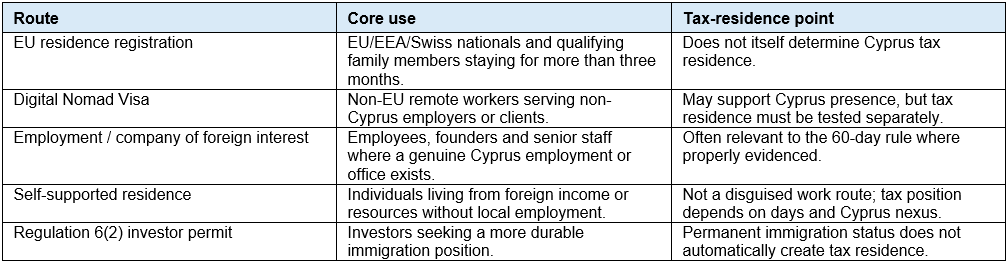
EU, EEA and Swiss nationals benefit from the EU free movement framework. Where they intend to stay in Cyprus for more than three months, they must obtain the relevant residence documentation, commonly referred to in practice as the Yellow Slip. The basis may be employment, self-employment, sufficient resources, study or family rights.
For non-EU family members of EU citizens, the analysis is not the same as for ordinary third-country nationals. Their rights may be derivative from the EU citizen and should be documented by reference to the applicable EU free movement regime.
The Cyprus Digital Nomad route is intended for non-EU and non-EEA nationals who work remotely through technology for an employer or clients outside Cyprus. It is not designed for local employment, local clients or ordinary participation in the Cyprus labour market. It should therefore not be marketed as a substitute for an employment permit or as a clear route to permanent residence without separate analysis.
Employment-based residence, including the companies-of-foreign-interest framework, is often the more relevant route where a founder, director, manager or specialist will perform real functions in Cyprus. Immigration, payroll, social insurance, board governance and tax-residence evidence should be aligned from the outset.
Self-supported or financially independent residence is different again. It may be suitable where the applicant lives from foreign income or resources without local work. It should not be used where the facts indicate active Cyprus employment or business operation.
For many third-country national investors, the commercially important durable route is the immigration permit under Regulation 6(2). The official investor framework refers to qualifying investment categories such as new residential immovable property, other immovable property, share capital of a Cyprus company with activity and personnel in Cyprus, and qualifying investment fund units.
The route may provide a more stable immigration position than ordinary temporary residence. However, it is not unconditional and should not be equated with tax residence or citizenship. The applicant must evidence the investment, payment trail, source of funds, income, accommodation, family position and continuing connection with Cyprus.
Cyprus tax residence for individuals is determined separately from immigration status. Broadly, an individual is Cyprus tax resident if he or she spends more than 183 days in Cyprus during the tax year. Cyprus also operates a 60-day rule for internationally mobile individuals with sufficient Cyprus nexus.
In broad terms, the 60-day rule requires at least 60 days in Cyprus, no more than 183 days in any other single country, a permanent home in Cyprus, and a Cyprus business, employment or office during the relevant year. If the relevant Cyprus business, employment or office ceases during the year, the individual may cease to qualify under the 60-day rule for that year.
Current official materials indicate that the previous requirement to prove that the individual was not tax resident elsewhere has been removed from the 60-day rule. This may make Cyprus more accessible for mobile individuals, but it increases the importance of treaty analysis where another jurisdiction also asserts tax residence.
Cyprus tax residence should also be considered with the non-domiciled regime. A Cyprus tax resident individual who is not domiciled in Cyprus may be exempt from Special Defence Contribution on certain categories of income, including dividends and passive interest, subject to the applicable conditions.
This remains a central attraction for internationally mobile investors and business owners. However, non-dom treatment should not be treated as automatic. The adviser should consider domicile, the number of years of Cyprus tax residence, the source and nature of income, General Healthcare System contributions where relevant, foreign tax exposure and treaty residence.
A Regulation 6(2) investor living mainly abroad may hold a Cyprus immigration permit but not be Cyprus tax resident. A digital nomad may live lawfully in Cyprus but still needs to satisfy the tax-residence rules. A founder or director may rely on Cyprus employment, business or office-holding for 60-day rule purposes only where the role is genuine and properly evidenced.
The strongest files are those where the immigration file, tax residence file, company records, bookkeeping, board minutes, payroll, banking and travel evidence all tell the same factual story. For business owners and investors, Cyprus planning should be route-specific, evidence-led and integrated.
Cyprus continues to offer a flexible and commercially attractive framework for residence, tax residence and business relocation in 2026. The main options include EU residence registration, digital nomad residence, employment-based residence, self-supported residence and investor permanent residence under Regulation 6(2).
At the same time, immigration residence and tax residence must be assessed separately. The 183-day rule, the 60-day rule and the non-domiciled regime each require their own evidence and legal analysis. The practical lesson for advisers is clear: select the correct residence route, document the Cyprus nexus, align the corporate and payroll position, and verify the applicable official criteria at the time of advice, filing or renewal.
No. Immigration residence and tax residence are separate. The person must separately satisfy the 183-day rule or the 60-day rule, and treaty analysis may be required where another jurisdiction also asserts tax residence.
No. EU residence registration confirms residence documentation for immigration purposes. It does not itself determine Cyprus tax residence.
It may support a factual Cyprus presence, but tax residence must still be tested separately. A digital nomad should review day count, accommodation, employment or business facts and any treaty tie-breaker.
No. Regulation 6(2) is an investor immigration permit. It does not by itself create citizenship or Cyprus tax residence.
It is a Cyprus tax residence route for internationally mobile individuals with sufficient Cyprus nexus, including at least 60 days in Cyprus, a permanent Cyprus home and Cyprus business, employment or office-holding during the relevant year.
It is a Special Defence Contribution concept. A Cyprus tax resident who is not domiciled in Cyprus may be outside Special Defence Contribution on certain income categories, subject to the applicable conditions.
Travel records, housing evidence, employment or office documents, payroll, board minutes, company accounts, banking records, source-of-funds evidence and tax filings may all be relevant, depending on the route.
Articles are provided for general informational purposes by an authorised corporate services provider and do not constitute legal advice.

Receive updates with practical insights on international business, law, tax, accounting, and compliance.
Be the first to hear about our latest discounts and special offers!
Follow our Telegram channel for offshore industry news:
Want updates by e-mail?
Enter your email address below to subscribe to our newsletter!