

Eltoma Corporate Services — Authorised Corporate Services Provider
Articles are provided for general informational purposes by an authorised corporate services provider and do not constitute legal advice.

The appropriate Cyprus residence route depends on the applicant’s nationality, intended work, source of income, investment, family position and desired duration of stay. EU citizens use the Union registration regime; remote workers may consider the Digital Nomad Visa; active founders and executives generally require an employment-based route; financially independent applicants must avoid local work; and qualifying investors may seek permanent residence under Regulation 6(2). Immigration residence, work authorisation and tax residence must be analysed separately.
For third-country nationals considering Cyprus as a European base, the first advisory question is not which form should be filed. It is which residence route accurately reflects the client’s real purpose of stay. The uploaded source material identifies five principal pathways commonly considered in Cyprus planning: EU/EEA/Swiss registration, the Digital Nomad Visa, employment-based work permits, Category F or financially independent residence, and investor permanent residence under Regulation 6(2). A professional article should address those pathways, but it should do so by reference to legal classification rather than marketing terminology.
This is particularly important for investors, founders and mobile professionals from Russia, Ukraine, China and other third countries. Their Cyprus planning frequently combines family relocation, company formation, banking, payroll, tax residence, non-dom analysis and long-term residence objectives. A route that is suitable for a passive investor may be unsuitable for a founder who intends to manage an operating business in Cyprus. Equally, a residence route that permits lawful stay may not, without more, support Cyprus tax residence or future citizenship planning.
Legal observation: the strongest Cyprus files are route-specific, evidence-led and consistent across immigration, corporate, tax, payroll and banking records.
A practical Cyprus residence analysis should begin with the applicant’s factual position. Is the person an EU citizen, a third-country national family member of an EU citizen, an employee, a founder, a passive investor, a remote worker, a financially independent individual, or a dependant? Each classification leads to different evidence and different legal consequences.
The adviser should avoid relying on labels such as “investor”, “founder”, “digital nomad” or “permanent resident” before the legal basis has been confirmed. A shareholder may be economically significant but still require an employment-based analysis if he or she will work in Cyprus. A digital entrepreneur may look like a remote worker, but if services are supplied to Cyprus clients, the digital nomad route may be inappropriate. A financially independent person may qualify as a self-supported resident, but not if the real intention is to operate locally.
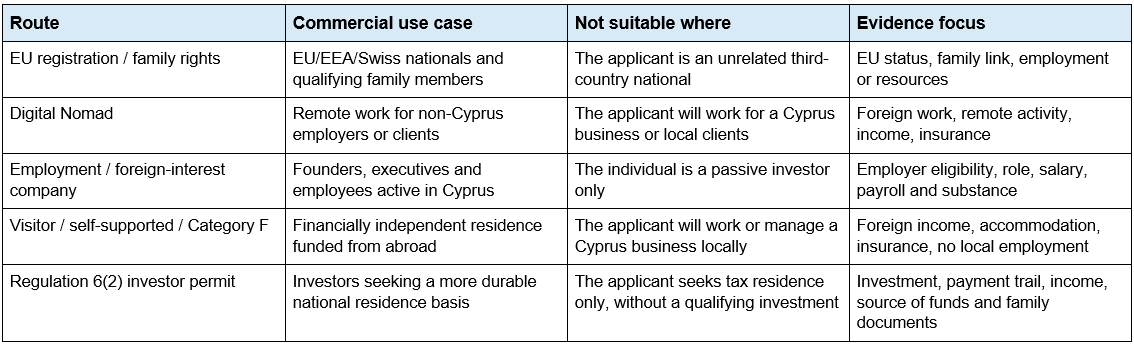
EU/EEA/Swiss citizens are not analysed in the same way as ordinary third-country nationals. Official Cyprus material confirms that Union citizens may reside for up to three months with only a valid identity card or passport, and must submit the application for a Registration Certificate within four months of entry where they remain for longer than three months [1].
The key professional point is correct categorisation. An employed EU citizen, self-employed professional, student, economically self-sufficient person and family member may all be eligible, but the document set should match the actual basis of residence. Third-country national family members of EU citizens are analysed under the residence-card regime and not under the ordinary investor or employment routes [2].
The Digital Nomad Visa is a temporary route for non-EU and non-EEA nationals who perform work remotely using telecommunications technology for an employer registered abroad or for clients located abroad. Official Cyprus material refers to a minimum stable monthly net income of EUR 3,500 after deductions and confirms that family members may be granted residence for the same period, without the right to be employed or perform economic activity in Cyprus [3].
This route may suit technology consultants, foreign-employed executives and online service providers whose work remains outside the Cyprus market. It is not appropriate where the person intends to work for a Cyprus company, provide services to Cyprus clients or act as part of a Cyprus operating business. Nor should it be marketed as a straightforward permanent residence route. It is best treated as a temporary remote-working solution, with any tax residence or long-term residence analysis undertaken separately.
For active business relocation, employment-based residence may be more appropriate than a passive investor or visitor route. Cyprus official material distinguishes employment categories and refers to companies of foreign interests within the strategy for attracting investment and talent. The Business Support Centre materials indicate that a company seeking registration as a foreign-interest company must satisfy ownership and investment criteria, including majority third-country ownership and evidence of investment of EUR 200,000 for operating the business in Cyprus [4].
This route is often central for founders, senior managers and key employees who will actually work in Cyprus. The file should therefore connect the immigration analysis with the employer’s eligibility, employment contract, salary, payroll treatment, social insurance position and the company’s real substance. Incorporating a Cyprus company is not, by itself, a personal right to reside and work in Cyprus.
Some clients do not intend to work in Cyprus at all. They may wish to live in Cyprus while being supported by foreign income, savings, pensions, dividends or other passive sources. Official Migration Department material confirms that visitor residence does not allow employment, and that Category F immigration permits are relevant to persons who do not work in Cyprus and have secured annual income from abroad [6] [8].
The practical risk is misclassification. A financially independent route should not be used where the applicant will in reality manage a Cyprus business, invoice local clients or perform local services. Advisers should also distinguish between a temporary visitor or self-supported position and an immigration permit. The documentary emphasis will normally be on foreign income, accommodation, health insurance, clean immigration history and consistency with the declared non-employment position.
The Regulation 6(2) investor immigration permit remains the principal national permanent residence route for many third-country investors. Official Migration Department materials identify qualifying investment categories, including residential immovable property, other immovable property, investment in the share capital of a Cyprus company with physical presence and employees in Cyprus, and qualifying investment fund units. The official criteria refer to a EUR 300,000 investment basis and to income evidence, source-of-funds documentation and family-member rules [7].
This route is commercially attractive where the client is prepared to make a qualifying capital commitment and wants a more durable residence basis. It should not be confused with tax residence. An investor may hold a Cyprus immigration permit but remain non-resident for Cyprus tax purposes if the individual does not satisfy the relevant tax residence test. The investment file should therefore be separated from, but coordinated with, the client’s personal tax residence strategy.
Family analysis should be undertaken at the beginning of the file, not after the principal applicant’s route has been selected. In some cases family members hold derivative rights. In other cases they may require separate applications, separate documentation or separate status analysis. Official investor-permit materials, for example, contain specific rules for spouses and minor children, while EU family-member cases fall under a different framework [2] [7].
For internationally mobile families, the route may be legally available for the principal applicant but unattractive if it does not support the intended position of the spouse, children or dependent adults. Advisers should therefore confirm whether family members will have residence only, employment rights, education continuity, renewal certainty, or a longer-term route to independent status.
Although this article focuses on immigration route selection, tax residence should be flagged because it is frequently the commercial reason for relocation. Cyprus tax residence is not created automatically by immigration residence. The Tax Department materials describe the 183-day rule and the 60-day rule, and also address domicility and Special Defence Contribution implications [9].
The adviser should therefore keep the analysis in two columns. The immigration column asks whether the person may lawfully reside and, where relevant, work in Cyprus. The tax column asks whether the person’s days, home, employment, business or office-holding position and wider treaty position support Cyprus tax residence. The same evidence - such as tenancy records, board minutes, payroll records and travel history - may be relevant to both columns, but the legal tests remain distinct.
The main advisory risk is allowing commercial preference to override legal classification. A passive investor should not be documented as an employee unless there is genuine employment. A founder should not rely on visitor status if he or she will work locally. A digital nomad should not provide services to Cyprus-based clients under a route designed for foreign work. A permanent residence label should not be used unless the status and conditions support it.
The practical protection is to re-check official criteria at the point of filing, preserve evidence from the outset and ensure that the residence file is consistent with the corporate, tax, payroll, accounting and banking file. For third-country investors and entrepreneurs, Cyprus can be an effective EU base, but the route must match the facts. The correct question is not which pathway is most attractive in general, but which pathway is legally sustainable for this client, this family and this business model.
A founder who will actively manage or work for a Cyprus business should normally begin with an employment and work-authorisation analysis. Share ownership or company incorporation alone does not confer a personal right to reside and work.
The route is designed for remote work for an employer established abroad or clients located abroad. Local employment or services to Cyprus clients may be incompatible with the route and should be assessed before filing.
No. The investment, payment, income, source-of-funds, family and other official criteria for the Regulation 6(2) route must be satisfied. A property purchase alone should not be treated as an automatic entitlement.
Visitor and Category F routes are premised on foreign or otherwise qualifying resources and generally do not permit local employment. An applicant intending to work or manage a Cyprus business should consider an appropriate employment route.
No. Immigration status and tax residence are separate. Tax residence must be tested under the applicable 183-day or 60-day rule and, where relevant, treaty rules and the person’s complete facts.
The answer depends on the route and the family relationship. Some family members have derivative rights; others need separate applications or evidence. Work rights and future independent status should also be checked.
They should be checked when the route is selected and again immediately before filing. Immigration criteria, documentary requirements, quotas and administrative practice may change.
Articles are provided for general informational purposes by an authorised corporate services provider and do not constitute legal advice.

Receive updates with practical insights on international business, law, tax, accounting, and compliance.
Be the first to hear about our latest discounts and special offers!
Follow our Telegram channel for offshore industry news:
Want updates by e-mail?
Enter your email address below to subscribe to our newsletter!