

Eltoma Corporate Services — Authorised Corporate Services Provider
Articles are provided for general informational purposes by an authorised corporate services provider and do not constitute legal advice.

A Hong Kong company compliance review is a structured check that confirms whether the company’s public filings, internal statutory records, accounting evidence, tax position, ownership information, banking profile and actual business activity remain consistent. It is not another annual filing. It is a preventive review designed to identify gaps before they become Companies Registry, Inland Revenue Department, bank, audit or governance issues.
The review is especially useful for foreign-owned companies, re-domiciled companies, group structures, companies preparing for audit or tax filing, and companies that have changed directors, shareholders, activities, banks or service providers during the year.
Hong Kong companies often treat compliance as a series of separate tasks. The annual return is filed with the Companies Registry, the Business Registration Certificate is renewed, accounting records are prepared for audit, Profits Tax Returns are handled by tax advisers, and bank due diligence is answered when the bank asks questions.
This approach may work while the company is simple and unchanged. It becomes risky when ownership, directors, business activity, bank transactions or group arrangements change during the year. The company may then have records that are individually correct in one place, but inconsistent when viewed together.
The practical purpose of a compliance review is to test whether all records still tell one coherent compliance story. A filing may have been submitted on time, but the company may still have a problem if the internal register, board approval, accounting treatment, tax schedule and bank explanation do not match.
A useful review should normally test four areas. First, whether the public record at the Companies Registry is accurate. Secondly, whether the internal statutory file is complete and up to date. Thirdly, whether accounting, audit and tax records support the business position reported by the company. Fourthly, whether the bank and due diligence profile matches the company’s actual transactions and commercial activity.
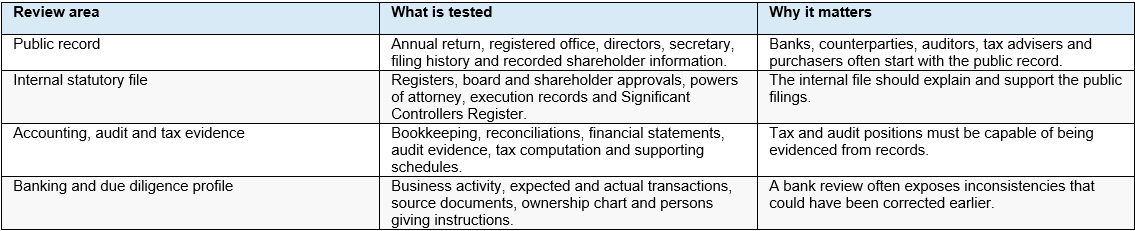
The public record is often the first source checked by banks, counterparties, tax advisers, auditors and prospective purchasers. A compliance review should therefore confirm that the information shown at the Companies Registry is accurate and consistent with the company’s internal records.
The review should cover the company name and status, registered office, directors, company secretary, shareholder information reflected in the latest annual return, filing history and any notices filed after incorporation. The purpose is not merely to confirm that a form was submitted, but to confirm that the public record accurately reflects the current position.
For a local private company, the annual return must be delivered within 42 days after the anniversary of incorporation. For a re-domiciled private company, the 42-day period runs after the anniversary of the re-domiciliation date. A practical review should ask whether the annual return was filed on time, whether it was accepted, and whether the information in it matched the actual governance and ownership position on the return date.
The internal statutory file should support the public record and explain how the company reached its current position. This is particularly important where there have been changes in directors, shareholders, company secretary, registered office, share capital or control arrangements.
The review should cover the register of members, register of directors, register of company secretaries, Significant Controllers Register, share transfer and allotment records, board resolutions, shareholder resolutions, written approvals, powers of attorney and execution records. Where the company has changed service provider, the handover file should also be reviewed.
A filing may be technically submitted but still leave a compliance gap if the company’s internal register, board approvals, ownership chart, bank file and adviser records do not match it. The review should therefore look for consistency, not merely filing evidence.
Business registration is another area where records can become outdated. A company may begin with one business model and later change its activity, address, trading name, branch arrangements, customer jurisdictions or licensing exposure.
The Inland Revenue Department requires business registration within one month of commencement of business and requires changes in registered particulars to be notified within one month. It also explains that business registration is not a licence to trade and does not regulate the business activity itself.
A compliance review should therefore consider whether registered particulars still describe the actual business and whether a change of activity has created additional licensing, tax, payroll, AML/CFT or due diligence issues.
Accounting, audit and tax should not be reviewed in isolation. The accounts should explain bank activity; the audit file should support the financial statements; and the tax computation should reconcile with accounting records and supporting schedules.
The Companies Registry explains that directors must prepare financial statements for each financial year in accordance with the Companies Ordinance and that financial statements must be audited, except for dormant companies. The Inland Revenue Department requires corporations and partnership businesses with gross income during the basis period to file Profits Tax Returns together with supporting documents, subject to specified exceptions.
A practical review should check whether bookkeeping is complete, bank balances and movements are reconciled, intercompany balances are confirmed, director and shareholder loan accounts are explained, related-party transactions are supported, and any offshore profits, capital or other technical tax position is properly evidenced.
A compliance review should not only ask whether annual accounts were prepared. It should ask whether the underlying records still exist and can be retrieved when required.
The Inland Revenue Department states that every person carrying on a trade, profession or business in Hong Kong must keep sufficient records in English or Chinese of income and expenditure to enable assessable profits to be readily ascertained, and that such records must be retained for not less than seven years.
In practice, the review should check whether contracts, invoices, bank statements, receipts, payment instructions, payroll records, loan agreements, related-party documentation and correspondence supporting major transactions are available and organised.
The compliance file should show that directors exercised oversight. Directors are not expected to prepare every filing or accounting schedule personally, but they should understand the company’s activity, approve material decisions and ensure that advisers receive clear instructions.
This part of the review should examine whether directors receive adequate management information, whether board approvals exist for material transactions, whether resolutions match the transactions recorded in the accounts, and whether the company secretary, accountant, auditor and tax representative have consistent instructions.
The Companies Registry advises directors to read its Guide on Directors’ Duties. In practical terms, a compliance review helps directors demonstrate that they did not merely rely passively on advisers, but maintained oversight of the company’s affairs.
Ownership and control information appears in more than one place. It may be reflected in the annual return, register of members, Significant Controllers Register, group chart, due diligence file, bank file, auditor’s records and tax adviser’s working papers. These records should not tell different stories.
The Significant Controllers Register regime requires Hong Kong-incorporated and re-domiciled companies to obtain and maintain up-to-date beneficial ownership information and keep the register available for inspection by law enforcement officers upon demand. Separately, the TCSP AML/CFT Guideline requires a licensed trust or company service provider to identify beneficial owners and understand ownership and control.
The review should therefore check whether ownership charts, nominee arrangements, shareholder registers, control rights and bank due diligence explanations are consistent. The same facts may be used in different processes, but each process has its own purpose and evidential standard.
Bank reviews often expose inconsistencies that could have been identified earlier. A bank may compare the company’s declared business activity with actual transactions, customer and supplier jurisdictions, third-party payments, loan movements, source of funds and source documents.
A compliance review should test whether the company can explain major receipts and payments and whether the accounting records match bank activity. It should also check whether the company’s business has changed since bank onboarding and whether the bank profile should be updated before the next periodic review.
This is not only a banking issue. If bank movements cannot be explained, the same issue may affect bookkeeping, audit, tax reporting and professional due diligence.
Most compliance problems are consistency problems. They often arise because each record was updated separately, rather than because the company deliberately ignored compliance.
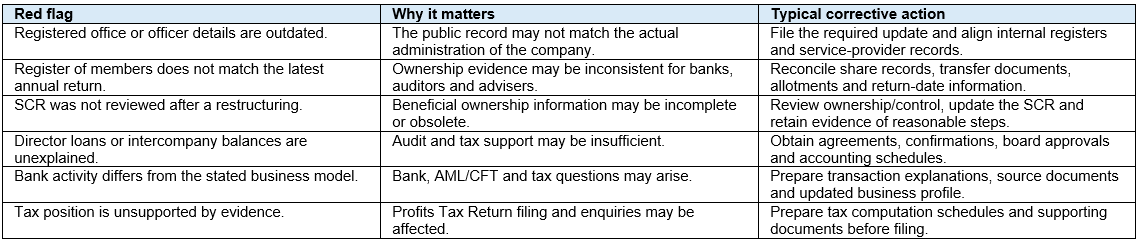
A review is particularly useful annually before the annual return and tax filing cycle, before audit work begins, before opening a bank account or responding to a bank review, before a share transfer or allotment, before a group restructuring, before sale of the company, after a change of directors or shareholders, after a change of company secretary or service provider, after re-domiciliation into Hong Kong, or after a material change in business activity or transaction flows.
The review is most effective when performed before an external party raises questions. It is easier to correct a record, obtain a missing approval or document a transaction while the people involved and source evidence are still available.
A good compliance review should produce a clear output, not only a list of concerns. The output should state which areas were reviewed, which documents were checked, which discrepancies were found, what the risk level is, what corrective action is recommended, who is responsible, what the deadline is and what evidence will confirm completion.
The review should also identify matters requiring legal, tax, audit or AML/CFT advice. Some issues can be corrected by filing a missing form or updating an internal register. Others may require professional judgement, retrospective documentation, tax analysis or communication with a bank or authority.
Eltoma may assist with a structured Hong Kong company compliance review covering statutory records, Companies Registry filings, Significant Controllers Register records, accounting evidence, tax filing readiness, bank-profile consistency and service-provider handover issues. The review should be tailored to the company’s facts and does not replace specific legal, tax, audit or banking advice where such advice is required.
A Hong Kong company compliance review is a preventive exercise. It helps directors and advisers confirm that statutory records, public filings, accounting evidence, tax filings, ownership information, bank data and operational reality remain aligned.
This is especially important for foreign-owned companies, re-domiciled companies, group structures and businesses preparing for audit, tax filing, bank review, restructuring or sale. The objective is not to duplicate ordinary annual administration, but to identify inconsistencies before they become regulatory, banking, tax or governance problems.
A Hong Kong company compliance review is a structured check of the company’s public filings, internal statutory records, accounting evidence, tax position, ownership information, bank profile and actual business activity. Its purpose is to identify inconsistencies before they create filing, audit, tax, banking or governance problems.
No. The annual return is a specific Companies Registry filing. A compliance review is broader. It checks whether the annual return, internal registers, board approvals, accounting records, tax files, bank records and operational facts are aligned.
A review is useful annually before the filing and tax cycle, before audit work, before bank onboarding or periodic bank review, before a share transfer, restructuring or sale, and after changes in directors, shareholders, business activity, bank profile or service provider.
Accounting records support audit, tax filing, bank explanations and management decisions. If bank movements, invoices, loans or related-party transactions cannot be reconciled, the same issue may affect the audit file, tax computation and professional due diligence.
Yes. A Hong Kong company that is required to keep a Significant Controllers Register should review it when ownership, voting rights, control arrangements, nominee arrangements or group structures change. The SCR should align with the company’s ownership chart, TCSP due diligence and bank file.
A company secretary or TCSP can coordinate much of the process, but directors should remain involved. Directors should understand the company’s activity, material decisions, records and filings, and should ensure that professional advisers receive accurate instructions.
The output should identify the areas reviewed, documents checked, discrepancies found, risk level, corrective actions, responsible persons, deadlines and evidence required to confirm completion. Some issues may require legal, tax, audit or AML/CFT advice.
Articles are provided for general informational purposes by an authorised corporate services provider and do not constitute legal advice.

Receive updates with practical insights on international business, law, tax, accounting, and compliance.
Be the first to hear about our latest discounts and special offers!
Follow our Telegram channel for offshore industry news:
Want updates by e-mail?
Enter your email address below to subscribe to our newsletter!