

Eltoma Corporate Services — Authorised Corporate Services Provider
Articles are provided for general informational purposes by an authorised corporate services provider and do not constitute legal advice.

A Hong Kong company budget should not be limited to the incorporation fee. After registration, investors should budget for official government fees, company secretary and registered office services, accounting records, audit, Profits Tax Return support, business registration renewal, annual return filing and compliance work required by banks or trust and company service providers. The exact cost depends on the company’s activity, ownership structure, transaction volume, banking profile and quality of records.
The practical issue is therefore not simply how cheaply a company can be formed. The better question is whether the company can remain legally maintained, bankable, auditable and tax-compliant after incorporation.
A useful cost comparison separates three categories: official statutory fees, professional service fees and risk-driven or event-driven compliance costs.
Official fees are set by public authorities. The Companies Registry publishes the main fees under the Companies Ordinance. The fee for incorporating a local company having a share capital is currently HK$1,545 for electronic delivery and HK$1,720 for hard-copy delivery, with business registration fee and levy payable separately. The Inland Revenue Department publishes the Business Registration Fee and Levy Table. For a Business Registration Certificate commencing between 1 April 2026 and 31 March 2027, the table shows HK$2,350 for a one-year certificate and HK$6,170 for a three-year certificate. These figures should be checked against the official tables at the time of action.
Professional fees depend on scope. A proposal may include only incorporation filing, or it may also include company secretary, registered office, statutory records, accounting set-up, bank-account preparation, tax filing support and TCSP compliance. Risk-driven costs arise where additional due diligence, beneficial ownership review, source-of-funds analysis, remedial filing or urgent professional work is required.
The first-year budget should cover the creation of an operating corporate infrastructure. A newly incorporated Hong Kong company commonly needs company secretary support, a registered office, statutory registers, a Business Registration Certificate, client due diligence by the service provider, initial accounting set-up and preparation for bank or payment-account onboarding.
For a foreign-owned company, these items are not optional extras. The registered office and company secretary support the statutory record. The accounting system records the first transactions. The banking readiness file helps explain ownership, control, business purpose, expected counterparties and funding. Without this foundation, the company may be incorporated but commercially unready.
After the first year, the company will usually have recurring annual costs. These normally include annual return filing, Business Registration Certificate renewal, company secretary renewal, registered office renewal, bookkeeping, audit coordination, Profits Tax Return preparation, tax computation, document retention and periodic compliance updates.
The annual return illustrates the point. A local private company must deliver Form NAR1 within 42 days after the anniversary of incorporation or re-domiciliation. The annual registration fee is HK$105 if filed on time. If filed late, the Companies Registry states that the fee can increase from HK$870 to HK$3,480 depending on the delay. Late filing can also expose the company and responsible persons to prosecution and default fines.
Audit should also be treated as part of annual maintenance. The Companies Registry explains that audit of financial statements is required for all companies, except dormant companies, even where a company qualifies for reporting exemption. This is often misunderstood by investors from jurisdictions where small private companies may be audit-exempt.
Two companies incorporated on the same day may have very different annual administration costs. The difference is usually driven by the company’s activity, records and risk profile rather than by the incorporation date.
Cost drivers include the number of transactions, number of bank accounts, currencies used, shareholders and directors, ownership layers, nominee arrangements, related-party transactions, overseas counterparties, audit adjustments, record quality and whether the company is active, dormant or newly trading.
A layered ownership structure, politically exposed person connection, higher-risk jurisdiction, unusual funding route or unexplained third-party payment may require additional client due diligence, beneficial ownership analysis, source-of-funds evidence and record-keeping. A low quotation may assume a simple, low-risk and well-documented company. If that assumption is incorrect, additional time and fees are likely.
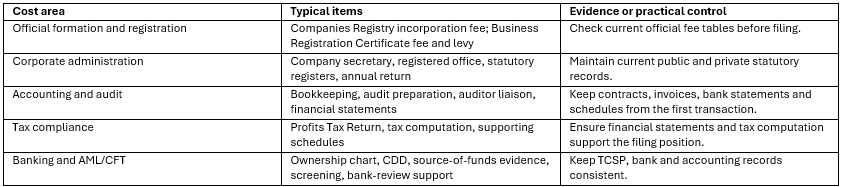

The most expensive Hong Kong company is often not the company with the highest planned annual service fee. It is the company that was poorly maintained and later requires urgent remedial work.
Hidden costs may arise from late annual returns, rejected filings, expired business registration, missing accounting records, delayed audit, unsupported tax computations, inconsistent ownership information, incomplete bank due diligence material or failure to notify changes in directors, secretary, shareholders or registered office.
These weaknesses can create wider commercial consequences. A bank may question outdated public records. An auditor may delay reporting because accounting evidence is incomplete. A tax adviser may be unable to support the Profits Tax computation. A potential buyer, investor or counterparty may treat poor records as a governance concern.
Bank-account or payment-account support should be defined carefully. Preparing documents, introducing a bank or payment institution, assisting with communication and supporting an ongoing bank review are different services.
No provider can responsibly guarantee ordinary bank approval merely because a company has been incorporated. Banks and payment providers assess ownership, control, business model, jurisdictions, transaction profile and source of funds. Where the business is new, cross-border or complex, preparing a credible banking readiness file may require substantial professional input.
TCSP and anti-money laundering compliance should also be recognised as part of the real cost of service delivery. A regulated provider cannot treat onboarding as a casual administrative exchange. Beneficial ownership review, customer due diligence, sanctions screening, source-of-funds questions and record-keeping all take professional time.
Initial set-up budget: incorporation, business registration, company secretary, registered office, statutory registers, compliance onboarding, accounting set-up and banking or payment-account preparation.
Annual maintenance budget: annual return, business registration renewal, company secretary and registered office renewal, bookkeeping, audit, Profits Tax Return, tax computation, document retention and compliance updates.
Event-driven budget: changes of director, shareholder or registered office; share transfers or allotments; certified company documents; additional due diligence; bank review; reactivation of a dormant company; restructuring; deregistration; or remedial filings.
This framework helps avoid a common mistake: treating incorporation as the principal cost and annual administration as an afterthought.
Assume an investor forms a Hong Kong company using a low-cost incorporation package. The package covers the filing, but excludes accounting set-up, audit preparation, tax computation support, bank-readiness documentation and additional beneficial ownership work. The company then starts trading through several currencies and receives funds from an overseas shareholder and a third-party payer.
The apparent saving can disappear quickly. The company may need urgent accounting reconstruction, source-of-funds explanations, updated ownership charts, late filing support and additional bank review assistance. A higher but clearer first-year proposal may therefore be cheaper in practice if it includes the work needed to keep the company usable and review-ready.
How Eltoma may assist
Eltoma can support Hong Kong companies by helping investors distinguish initial set-up costs, annual maintenance costs and event-driven compliance work. This may include company administration, TCSP compliance support, statutory record maintenance, accounting coordination, audit liaison, Profits Tax filing support and preparation of corporate records for bank or professional review.
This support does not guarantee bank approval, tax outcomes or regulatory acceptance. Its purpose is to help the company maintain a coherent, documented and review-ready corporate file.
Hong Kong remains an efficient and commercially attractive jurisdiction for international business. However, investors should not evaluate a Hong Kong company by the incorporation fee alone.
A sustainable budget should cover the cost of keeping the company legally maintained, bankable, auditable, tax-compliant and professionally administered. In many cases, proper administration from the beginning is cheaper than repairing a weak corporate record later.
The cost depends on the company’s activity, transaction volume, records, audit requirements, tax filing position and compliance risk. Investors should budget separately for official fees, company secretary and registered office services, bookkeeping, audit, Profits Tax Return preparation and event-driven changes.
No. The incorporation fee is only the starting point. A usable Hong Kong company normally needs ongoing administration, business registration renewal, statutory records, accounting, audit, tax filing support and compliance records. A low formation price may exclude many of these items.
In general, yes. The Companies Registry explains that audit of financial statements is required for all companies, except dormant companies. Reporting exemption may simplify reporting for qualifying companies, but it should not be confused with a general audit exemption.
A local private company must deliver Form NAR1 within 42 days after the anniversary of incorporation or re-domiciliation. The on-time annual registration fee is HK$105. Late delivery can result in substantially higher registration fees and possible enforcement consequences.
No. No professional provider can responsibly guarantee ordinary bank approval. Banks and payment providers assess ownership, control, business model, jurisdictions, transaction profile and source of funds. Professional support can improve file readiness, but it cannot guarantee approval.
Costs differ because companies differ. A simple dormant company and an active cross-border trading company with several bank accounts, currencies, related-party transactions and complex ownership will not require the same level of accounting, audit, tax and compliance work.
Useful documents include current statutory registers, accounting records, invoices, contracts, bank statements, ownership charts, beneficial ownership evidence, source-of-funds support and board or shareholder approvals. Consistent records usually reduce delay and remediation costs.
Articles are provided for general informational purposes by an authorised corporate services provider and do not constitute legal advice.

Receive updates with practical insights on international business, law, tax, accounting, and compliance.
Be the first to hear about our latest discounts and special offers!
Follow our Telegram channel for offshore industry news:
Want updates by e-mail?
Enter your email address below to subscribe to our newsletter!