

Eltoma Corporate Services — Authorised Corporate Services Provider
Articles are provided for general informational purposes by an authorised corporate services provider and do not constitute legal advice.

A Hong Kong company director may delegate administrative, accounting, tax and company secretarial work, but the director must not abandon oversight. The practical duty is to understand the company’s business, supervise delegated work, review material records, exercise independent judgement and ensure that important decisions, filings and financial reporting are properly authorised and documented.
This article follows the discussion of nominee directors in the Hong Kong knowledge-base series. The same principle applies more broadly to shareholder-directors, group-appointed directors, professional directors and directors of foreign-owned Hong Kong private companies. Directorship is not a passive title. It is a continuing governance role.
A director is not expected to perform every clerical or professional task personally. Accountants may maintain books, auditors may audit financial statements, company secretaries may prepare statutory filings and lawyers may review transaction documents. However, the director should remain informed, ask questions and ensure that the company has an organised system for decision-making, records and compliance.
Directors’ duties in Hong Kong arise from several sources: the Companies Ordinance, common law and fiduciary principles, the company’s articles of association, board resolutions and internal governance arrangements. The Companies Registry publishes A Guide on Directors’ Duties, which summarises the general principles directors should observe when performing their functions and exercising their powers.
The Companies Registry also reminds companies that limited liability comes with statutory obligations. Every officer of a company, including a director, company secretary or manager, is responsible for ensuring compliance with the Companies Ordinance. Non-compliance may expose the company and responsible persons to prosecution and default fines.
For investors and business owners, accepting a directorship should therefore not be treated as an administrative formality. A director should know what the company does, which advisers are involved, where records are kept, who may sign documents, when filings are due and how financial reporting is organised.
Section 465 of the Companies Ordinance requires a director to exercise reasonable care, skill and diligence. The standard uses both an objective and subjective test. It considers what may reasonably be expected of a person carrying out the director’s functions, and it also considers the director’s own knowledge, skill and experience.
This is particularly important for professional readers. A director with accounting, legal, tax, finance, banking or industry expertise should not ignore that expertise when reviewing company affairs. A passive approach may be difficult to justify where the director has the knowledge to recognise an issue and ask further questions.
A director should act in good faith for the benefit of the company as a whole and use powers for proper purposes. This is particularly relevant in owner-managed companies, investor-backed companies and group structures.
A director may have been nominated by a particular shareholder or group company, but the director’s office is exercised in relation to the Hong Kong company. Shareholder instructions, group finance instructions or beneficial-owner preferences should not be followed mechanically if the director does not understand the transaction or if the instruction appears inconsistent with the company’s position.
A practical governance test is useful: what is the company doing, why is it doing it, who benefits, who approved it, and how is the decision recorded?
Hong Kong companies commonly rely on professional advisers. A company secretary may handle statutory filings. A licensed corporate service provider may maintain the registered office and statutory records. Accountants may keep bookkeeping records. Auditors may audit financial statements. Tax advisers may prepare tax computations and returns. Lawyers may review transactions and execution documents.
This model is normal and often necessary. The director’s role is not to replace those advisers, but to understand what has been delegated and to supervise material matters. Directors should ensure that advisers have clear instructions, accurate information and authority to act. They should review important documents before approval and ask questions where figures, transactions or filing positions are unclear.
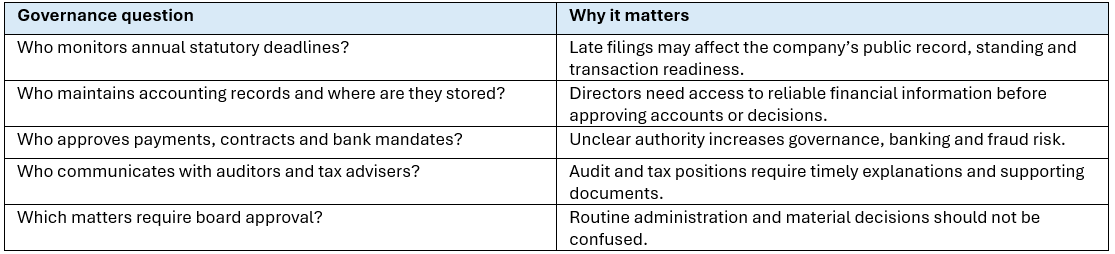
Directors should keep oversight of the company’s public record. The Companies Registry explains that companies must disclose and report specified information about the company, its officers and shareholders, and any changes in that information, so the public can access current information kept by the Registrar of Companies.
For a local private company, the annual return must generally be delivered in respect of every year within 42 days after the anniversary of incorporation. The annual return is not a tax return. It is part of the public corporate record. Changes in directors, company secretary, registered office and other statutory particulars must also be reported using the relevant specified forms within the prescribed periods.
A director should not assume that a filing is complete merely because it was requested from a service provider. Good governance requires confirmation that important filings have been delivered, accepted and reflected correctly on the public record. This is especially important before bank review, investor due diligence, audit, tax enquiries or a transaction.
Financial reporting is not only an accountant’s issue. Accountants may prepare records and auditors may audit financial statements, but directors should understand the company’s financial position and the basis on which financial statements are approved.
The Companies Registry states that audit of financial statements is required for all companies, including companies falling within the reporting exemption, except dormant companies. Directors should therefore ensure that accounting records are maintained from the first transaction and that audit queries are answered properly and promptly.
In practice, directors should pay attention to major balances, shareholder loans, director loans, related-party transactions, revenue recognition, unusual payments, supporting invoices, bank reconciliations and tax positions. Directors do not need to perform the bookkeeping themselves, but they should not approve accounts they do not understand.
Conflicts of interest are common in closely held companies. A person may be a director, shareholder, lender, consultant and counterparty at the same time. This is not automatically improper, but the issue must be identified and managed.
Directors should be alert to payments to shareholders, director loans, management charges, intercompany services, connected-party contracts, guarantees, asset transfers and arrangements where personal interests may differ from the company’s interests. The practical risk is not only the existence of a conflict. The greater risk is failing to disclose it, document it and obtain necessary approval before the company acts.
For legal and tax professionals, this is often where governance and tax evidence meet. A related-party charge may be commercially justifiable, but it should be supported by an agreement, board approval, accounting treatment and evidence of services or value transferred.
Directors should know who has authority to bind the company. This issue should not be left to informal practice. Ordinary commercial contracts, bank mandates, deeds, powers of attorney and high-value transactions may require different levels of approval and execution mechanics.
The company should maintain a clear record of who may sign routine documents, who may approve contracts, when a board resolution is required, when legal review is needed and how signed documents are stored. Electronic signing may be convenient, but it should still be supported by proper authority and record-keeping.
A director signing documents on behalf of the company should understand the nature of the document, the commercial purpose and whether the company has approved the transaction.
Many Hong Kong companies are owned or managed from outside Hong Kong. The Companies Registry confirms that a non-Hong Kong resident may be appointed as a director of a local limited company. Remote management is therefore common, but it requires clearer governance rather than less governance.
Where directors, shareholders, accountants and advisers are in different jurisdictions, the company should have a reliable process for approving decisions, transmitting instructions, storing records and responding to regulators, banks, auditors and tax advisers. Time-zone differences, language issues and dispersed records can quickly become compliance problems if no one controls the process.
A foreign-owned Hong Kong company should maintain a practical governance file: board resolutions, signing authorities, accounting records, tax correspondence, bank information, service-provider engagement letters and a record of who may give instructions on behalf of the company.
These measures are not designed to over-formalise an owner-managed company. They are intended to ensure that the company remains credible, auditable, bankable and properly controlled.
Eltoma may assist with Hong Kong company administration, statutory filing coordination, director and company secretary change filings, annual compliance calendars, accounting-record coordination, audit support and practical governance-file maintenance. The exact scope should be agreed by reference to the company’s structure, activity, service provider arrangements and regulatory status.
Acting as a director of a Hong Kong company is an active oversight role. A director does not have to manage every company secretarial, accounting, tax or administrative task personally, but should remain informed and exercise independent judgement.
The practical standard is simple: understand the company, supervise delegated work, review important records, ask questions when information is unclear and ensure that material decisions are properly authorised and documented.
For foreign-owned and professionally administered Hong Kong companies, this is particularly important. Good advisers can support compliance, but directors remain central to the governance framework. Directorship is therefore not a passive title; it is a continuing responsibility.
A Hong Kong company director should act in good faith for the benefit of the company, use powers for proper purposes, exercise reasonable care, skill and diligence, manage conflicts and supervise the company’s records, filings and material decisions. The precise duties depend on law, the company’s articles, board decisions and the company’s circumstances.
Yes. A Hong Kong director may rely on company secretaries, accountants, auditors, tax advisers, lawyers and corporate service providers. Delegation is not abdication. The director should understand what has been delegated, ensure advisers have accurate information and review material documents and decisions before approval.
No general rule requires a director of a local private company to be a Hong Kong resident. The Companies Registry confirms that a non-Hong Kong resident may be appointed as a director of a local limited company. The company must still satisfy director and company secretary requirements and maintain effective governance.
Section 465 requires a director to exercise reasonable care, skill and diligence. The standard combines what may reasonably be expected from a person carrying out the director’s functions with the director’s own knowledge, skill and experience. A director with professional expertise may be expected to apply that expertise.
No. Accountants and auditors may prepare and review financial information, but directors should understand the company’s financial position before approving financial statements. Directors should pay attention to major balances, related-party transactions, loans, unusual payments, bank reconciliations and tax positions.
A practical governance file should include board resolutions, signing authorities, bank mandates, accounting records, audit and tax correspondence, service-provider engagement letters, related-party approvals, conflict disclosures and a record of who may give instructions on behalf of the company.
Banks and investors often review whether the company’s public record, ownership, financial statements, tax position and approvals are consistent. A director who maintains proper oversight can help demonstrate that the company is credible, controlled, auditable and capable of explaining material decisions.
Articles are provided for general informational purposes by an authorised corporate services provider and do not constitute legal advice.

Receive updates with practical insights on international business, law, tax, accounting, and compliance.
Be the first to hear about our latest discounts and special offers!
Follow our Telegram channel for offshore industry news:
Want updates by e-mail?
Enter your email address below to subscribe to our newsletter!