

Eltoma Corporate Services — Authorised Corporate Services Provider
Articles are provided for general informational purposes by an authorised corporate services provider and do not constitute legal advice.

For a foreign business hiring in Hong Kong, an employer of record may be suitable for quick market testing, low headcount and reduced early administration. A company’s own Hong Kong entity is usually more appropriate where the business needs local contracts, bankability, visa sponsorship, licensing, control or a durable operating platform. Neither route removes Hong Kong employment, MPF, employer tax reporting or immigration analysis.
The choice is often described as a payroll or cost question. In practice, it is a structural decision. The same employee can create very different obligations depending on who is the legal employer, who directs the work, who signs contracts, who reports payroll, who sponsors immigration permission and how the business intends to grow in Hong Kong.
Salary is only one element of the Hong Kong hiring cost. An employment relationship also requires employment terms, payroll administration, statutory employment benefits, Mandatory Provident Fund enrolment, employer tax reporting and document retention. These functions must be handled either by the third-party employer under an employer of record arrangement or by the company’s own Hong Kong employing entity.
The Labour Department explains that an employment contract is an agreement on employment conditions between an employer and an employee. It may be oral or written, but written employment contracts are recommended because they help both parties understand obligations and reduce disputes.
Practical message: outsourcing employment administration may move operational responsibility, but it does not make Hong Kong employment rules irrelevant.
Employer of record, or EOR, is a commercial expression rather than a separate statutory category in Hong Kong employment legislation. The legal and tax analysis depends on the contracts and the actual facts. In a typical structure, a local third-party employer enters into the employment contract with the employee and provides employment administration for the overseas business whose operations benefit from the employee’s work.
Depending on the provider and the agreement, an EOR arrangement may cover the employment contract, payroll, leave administration, Mandatory Provident Fund enrolment and contributions, employer tax reporting, termination calculations and routine employment record-keeping.
This may be attractive where the overseas business wants to hire quickly, avoid early fixed entity costs or test whether Hong Kong requires a larger commitment. It may also reduce early administrative error while the business is still learning the local employment and tax reporting environment.
However, an EOR should not be treated as a universal substitute for a Hong Kong company. The business must still consider whether the employee will negotiate contracts, bind the overseas company, handle regulated activity, represent the business externally, manage funds, access confidential information or support a long-term market presence.
Where a business incorporates or uses its own Hong Kong company, that company normally becomes the employer and carries employment administration in its own name. This gives greater control, but it also brings corporate, employment, tax, accounting and governance obligations into one structure.
A Hong Kong private company must have at least one director who is a natural person and a company secretary. The company secretary requirements are localised: an individual company secretary should ordinarily reside in Hong Kong, while a corporate company secretary should have its registered or principal office in Hong Kong. Hong Kong company law does not generally require a director of a local limited company to be resident in Hong Kong.
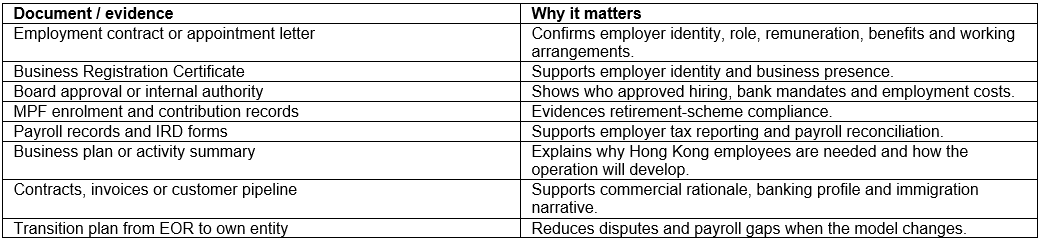
Business registration is also relevant where business is carried on in Hong Kong. The Inland Revenue Department states that every person carrying on business in Hong Kong must apply for business registration within one month from commencement, display a valid Business Registration Certificate at the place of business and notify changes in registered particulars within one month.
A Hong Kong entity is therefore not merely a payroll vehicle. It is a continuing corporate, employment, tax, accounting and governance platform.
Whether employment is administered by a third-party employer or by the company’s own entity, Hong Kong employment law remains relevant. Employment terms, wages, statutory holidays, annual leave, sickness allowance, maternity and paternity protection, termination notice, severance and long-service payments may become relevant depending on the facts.
A written employment contract is more than a formality. It identifies the employer, post, remuneration, benefits, employment period, place of work and termination arrangements. For a business comparing employment structures, the written contract is often the document that shows who carries the primary employment relationship.
A foreign business using an EOR should therefore review the full contract chain. It should understand who is the legal employer, who supervises the employee day to day, who holds employee records, who is responsible for statutory entitlements and how the arrangement can be ended or transferred if the business later hires directly.
The Mandatory Provident Fund system is a central part of the employment cost. The Mandatory Provident Fund Schemes Authority states that, except for exempt persons, employers must enrol full-time and part-time employees aged 18 to 64 who have been employed for a continuous period of 60 days or more in an MPF scheme within the first 60 days of employment.
The MPFA also states that an employer must not sign a series of employment contracts shorter than 60 days in order to avoid the obligation. Failure to enrol an employee on time may expose an employer to a maximum fine of HKD 350,000 and imprisonment for three years. Employer and employee mandatory contributions are generally calculated at 5% of relevant income, subject to statutory minimum and maximum relevant income levels.
For cost comparison, the business should ask who will enrol the employee, calculate contributions, submit information, maintain MPF records and deal with corrections. This is particularly important where the business expects to transition from EOR to own-entity employment.
The Inland Revenue Department issues Employer’s Returns of Remuneration and Pensions annually. Employers are required to complete and file the returns within the stated period, together with forms reporting remuneration paid to employees. Employers are also expected to keep payroll records for at least seven years.
Additional notification forms may be required for new employment, termination of employment, or employees who are about to leave Hong Kong permanently or for a substantial period. The IRD guidance refers, for example, to Form IR56E after employing a person who is likely to be chargeable to Salaries Tax, Form IR56F before termination and Form IR56G where the employee is leaving Hong Kong.
Under an EOR arrangement, these processes are usually handled by the third-party employer. Under own-entity hiring, they become part of the Hong Kong company’s internal finance and compliance calendar. Payroll is therefore a tax-reporting and record-keeping issue, not only a human-resources function.
Immigration can be decisive. Where the business expects to hire non-local employees, the ability to support an employment visa application may depend on having an identifiable Hong Kong employer with appropriate business evidence.
For General Employment Policy applications, the Immigration Department refers to employing-company documents such as an employment contract or appointment letter, Business Registration Certificate, proof of financial standing, company background information and, for newly set-up companies, a detailed business plan covering matters such as source of funds, business activities, expected turnover and proposed local posts.
This does not mean every hiring plan requires immediate incorporation. It does mean that visa sponsorship should be assessed before choosing the hiring model. An EOR may solve payroll administration, but the business should check whether it supports the intended immigration route and commercial narrative.
At very low headcount, an EOR arrangement may be commercially attractive. The business pays salary, statutory employment cost and a service fee without immediately carrying incorporation, company secretary, registered office, accounting, audit, tax and payroll infrastructure costs in its own entity.
As headcount grows, the calculation changes. EOR fees often increase per employee, while many own-entity costs are fixed or semi-fixed. A company secretary, registered office, accounting system and governance process may cost broadly similar amounts whether the company employs two people or ten.
The crossover point is not purely mathematical. A company may need its own entity earlier because customers require a Hong Kong counterparty, employees need to act under the company’s name, the business needs a bank account, a licence or a visa sponsor, or investors expect a local operating platform.
An EOR can support hiring, but it may not create the same commercial presence as a Hong Kong company operating in its own name. A business using an EOR may still be viewed as testing the market rather than establishing a durable Hong Kong operation.
A company’s own Hong Kong entity may be preferable where the business needs to sign customer or supplier contracts locally, issue invoices from Hong Kong, apply for licences or registrations, operate a bank account, employ staff under its own brand, build a local management team or show substance to banks, investors and counterparties.
Control also matters internally. Under the own-entity model, the company can create employment policies, signing authority, expense approval procedures, confidentiality arrangements, intellectual-property controls and reporting lines. Under a third-party employer model, some of these controls must be achieved contractually and may be less flexible.
Many businesses start with an EOR and incorporate later. That can be sensible, but the transition should be planned from the beginning. The difficult part is not only forming the company; it is moving employees, payroll records, MPF arrangements and employment documentation to the new employer without creating gaps or disputes.
A practical transition plan should address new employment contracts, continuity of service, accrued leave, statutory entitlements, payroll cut-off, MPF handover, employer tax reporting, employee communications, immigration sponsorship, bank payroll setup and transfer of records from the outgoing provider.
A rushed transition may cost more than the service fees the business hoped to save by leaving the EOR model.
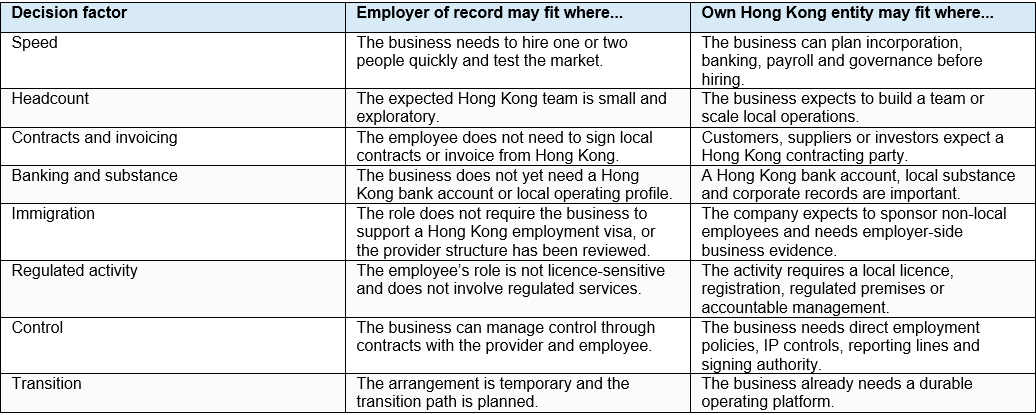
An EOR may be suitable where the business is testing Hong Kong, hiring one or two employees, moving quickly, avoiding early fixed costs or does not yet need a Hong Kong contracting entity. It may also help where the role is exploratory, the market case is uncertain or the business wants to learn more before creating a permanent local structure.
The arrangement should still be reviewed carefully where the employee will negotiate contracts, handle funds, manage regulated activities, access confidential information, supervise local operations or represent the company externally. Simplicity should not hide control, authority and risk questions.
Direct hiring through the company’s own Hong Kong entity may be more appropriate where the business expects to build a team, needs a Hong Kong bank account, intends to sponsor employment visas, will contract with Hong Kong customers or suppliers, requires licences or registrations, or wants to demonstrate local substance to banks, investors and counterparties.
It may also be more suitable where headcount is growing, the business needs long-term control over employment terms, or the company wishes to align employment, invoicing, banking, accounting and tax reporting within one local structure.
Eltoma may assist foreign businesses with Hong Kong company formation, company secretarial support, corporate compliance coordination, business-registration support, document preparation for banking discussions and coordination with employment, payroll, immigration, tax and legal advisers where specialist advice is required.
The scope should be defined case by case. Eltoma does not guarantee bank-account opening, visa approval, licensing approval or a particular tax result. The practical value is in helping the company prepare a coherent, accurate and verifiable corporate file before decisions are made.
There is no universal answer to the employer of record versus own entity question. An EOR can be a practical early-stage route where speed, low headcount and reduced administration are important. A company’s own Hong Kong entity may become more appropriate where the business needs control, scale, contracts, banking, immigration support, licensing, substance or a durable local presence.
The real cost of hiring in Hong Kong is therefore not only salary or service fees. It is the cost of choosing an employment structure that does not match the company’s stage of growth. The best decision is the one that aligns employment administration with the business plan, compliance responsibility and expected development of the Hong Kong operation.
Employer of record is normally a commercial expression, not a separate statutory employer category in Hong Kong employment legislation. The legal position depends on the contracts and facts, including who employs the worker, who directs the work, who pays remuneration and who carries statutory employer obligations.
An employer of record may be suitable where a foreign business is testing Hong Kong, hiring one or two employees, moving quickly and does not yet need a Hong Kong contracting entity, bank account or licence. The arrangement should still be reviewed where the employee has authority, handles funds or performs regulated activities.
Own-entity hiring is usually more appropriate where the business needs local contracts, a Hong Kong bank account, employment visa sponsorship, licences, growing headcount, direct control over employment terms or a durable Hong Kong operating presence.
No. The employment wrapper may change who administers MPF, but the MPF position still has to be handled properly. Except for exempt persons, relevant employees aged 18 to 64 who have been employed for 60 continuous days or more generally have to be enrolled within the first 60 days.
This depends on the facts, provider structure and immigration route. General Employment Policy applications require employer-side evidence. A business expecting visa sponsorship should assess early whether the EOR model is sufficient or whether its own Hong Kong entity is needed.
Not always. At low headcount, an employer of record can reduce early fixed costs. As headcount grows, own-entity costs may become more efficient because several corporate, accounting and governance costs are fixed or semi-fixed. Commercial control and banking needs may matter more than the arithmetic.
Yes, many businesses use an employer of record as an interim route and incorporate later. The transition should be planned carefully, including new contracts, continuity of service, accrued leave, MPF handover, payroll cut-off, employer tax reporting and employee communication.
Articles are provided for general informational purposes by an authorised corporate services provider and do not constitute legal advice.

Receive updates with practical insights on international business, law, tax, accounting, and compliance.
Be the first to hear about our latest discounts and special offers!
Follow our Telegram channel for offshore industry news:
Want updates by e-mail?
Enter your email address below to subscribe to our newsletter!