

Eltoma Corporate Services — Authorised Corporate Services Provider
Articles are provided for general informational purposes by an authorised corporate services provider and do not constitute legal advice.

A Hong Kong company is taxed on profits arising in or derived from Hong Kong, not automatically on all worldwide income. An offshore claim succeeds only where the company can show, through its actual profit-producing operations and contemporaneous records, that the relevant profits arose outside Hong Kong. A separate FSIE review is required for specified foreign-sourced passive income and disposal gains received in Hong Kong by an MNE entity.
Hong Kong’s territorial source principle is one of the most recognised features of its tax system. It is also one of the most frequently misunderstood by business owners. A Hong Kong company is not taxed on worldwide profits merely because it is incorporated in Hong Kong. Equally, profits are not offshore merely because the customer, supplier, bank account or payment currency is outside Hong Kong.
Hong Kong charges Profits Tax on profits arising in or derived from Hong Kong from a trade, profession or business carried on in Hong Kong. The Inland Revenue Department explains the three basic conditions for liability: a person carries on a trade, profession or business in Hong Kong; the business derives profits; and those profits arise in or are derived from Hong Kong.
The third condition - the source of the profits - is usually the difficult one. It cannot be determined only by looking at the place of incorporation, the place of bank receipt, the residence of the customer or the location of the shareholder. The source analysis requires a practical review of how the profit was actually earned.
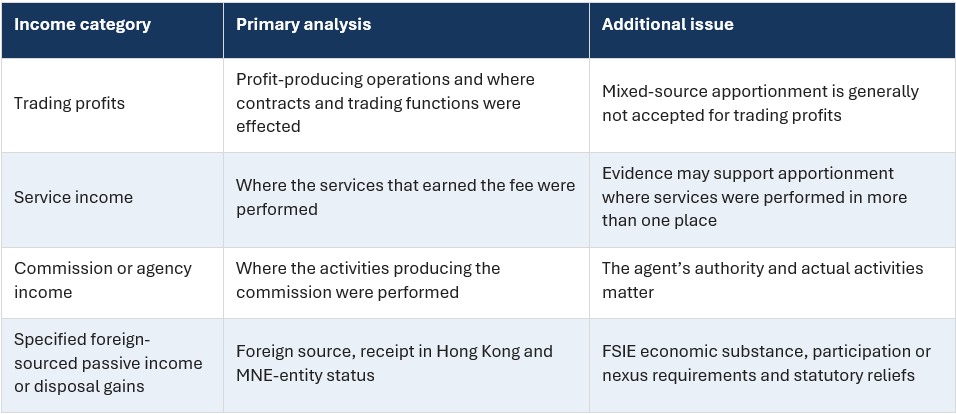
The ordinary source analysis is not the end of the review for every taxpayer. Under Hong Kong's foreign-sourced income exemption regime, specified foreign-sourced interest, dividends, intellectual property income and disposal gains received in Hong Kong by an entity within a multinational enterprise group may be chargeable to Profits Tax unless the applicable economic substance, participation or nexus requirement, or another statutory exclusion or relief, is satisfied. The refined regime applies to relevant non-intellectual-property disposal gains from 1 January 2024. Active trading and service income remains subject to the ordinary source rules, but mixed income streams must be classified before the offshore position is prepared.
The core question is simple to state but often difficult to prove: what did the taxpayer do to earn the profit, and where did the taxpayer do it? The relevant focus is on the taxpayer’s own profit-producing operations, not merely on the group’s overall activity and not on matters that are only antecedent or incidental.
This is why offshore claims are evidence-based. The company must identify the relevant income stream, the transactions that produced it, the people who performed the work, the place where the work was performed, and the documents that support that position.
For trading businesses, the place where purchase and sale contracts are effected remains an important factor. However, the IRD’s guidance makes clear that “effected” does not mean only formal legal signature. It may include negotiation, conclusion and execution of contract terms. The wider factual picture should be considered.
A trading company should therefore consider where, and by whom, the following functions were carried out:
A common misunderstanding is that overseas customers automatically make the profit offshore. That is not the correct test. If material trading operations are carried out in Hong Kong, the profits may still be Hong Kong-sourced. Conversely, where the relevant contracts and trading operations are genuinely carried out outside Hong Kong, an offshore position may be supportable if the evidence is consistent.
Service income, agency income and commission income require a different analysis from trading profits. For service fee income, the source is generally the place where the services giving rise to the fee are performed. For commission income, the focus is normally where the commission agent performs the activities that bring about the business between the principals.
This distinction matters in practice. A company that earns consulting fees should evidence where the actual consulting work, deliverables and client management took place. A sourcing or sales commission company should evidence where the activities leading to the transaction were performed. A group service company should be able to show who performed the services, for whom, under which agreement, and from where.
Where services are performed partly in Hong Kong and partly outside Hong Kong, apportionment may be relevant depending on the facts. That does not mean that a simple percentage can be selected without evidence. Time records, deliverables, employee location, travel records, project records and correspondence may be needed.
Management location is relevant, but it is not normally decisive on its own. A board meeting outside Hong Kong, a foreign address or an overseas bank account will not, by itself, prove that the profits are offshore. Similarly, day-to-day decisions in Hong Kong do not always resolve the entire source question if the relevant profit-producing transactions occurred elsewhere.
The practical question is whether the company has real operational substance where it says the profit was produced. Evidence may include overseas personnel, agents, premises, travel records, authority to negotiate and conclude contracts, service-delivery records, logistics records and commercial correspondence. A structure with overseas customers but no overseas operational activity may be weak if the actual work was performed in Hong Kong.
A company preparing an offshore claim should assemble evidence before the tax return is filed, not only after an IRD enquiry has been issued. Useful evidence may include:
The objective is not to create paperwork for its own sake. The objective is to show a coherent chain between the income, the profit-producing operations and the claimed source of the profit.
An offshore claim should be reflected in the Profits Tax Return and tax computation in a way that is understandable and supported by accounting records. The IRD’s notes to the Profits Tax Return require details of profits, income or interest claimed to have an offshore source and the related direct and indirect expenses.
A robust tax computation should therefore identify the offshore income, explain how the amount was calculated, show the expenses allocated to that income, and reconcile the claim to the audited financial statements and underlying accounting records. Where the company has both Hong Kong-sourced and offshore income, the basis of allocation should be reasonable, documented and consistent with the facts.
The IRD may raise enquiries into an offshore claim. Departmental guidance states that taxpayers should be ready to prove, with supporting documentary evidence, that a transaction profit was derived outside Hong Kong. The IRD may ask for detailed information about the operations of the transaction because those operations are central to the source analysis.
Typical enquiry areas may include who negotiated contracts, where contracts were concluded, who performed services, whether overseas agents had real authority, how goods were shipped, where payments were arranged, how expenses were allocated and whether the accounting records support the explanation.
Weak bookkeeping can damage an offshore claim even where the commercial position might otherwise be arguable. If the company cannot identify which invoices are claimed offshore, which expenses relate to those invoices, who performed the work, or how the bank receipts match the sales records, the claim becomes difficult to support.
Hong Kong record-keeping rules require persons carrying on business to keep sufficient records of income, expenditure, assets and liabilities so that assessable profits can be readily ascertained, and such records are generally retained for at least seven years. For offshore claims, this means that accounting records should be capable of linking the claim to transaction-level evidence.
Business owners often misunderstand the territorial source principle. The following statements are common, but incomplete:
The correct approach is not based on one isolated fact. The correct approach is to analyse all material operations that produced the profit and determine where those operations took place.
Before making an offshore claim, directors, finance teams and advisers should ask:
The IRD notes that advance rulings on the source of business profits are available to provide greater certainty, subject to the relevant procedures and fees. This may be useful where the amounts are material or the facts are complex.
Hong Kong’s territorial source principle remains an important feature of its tax system, but it should not be treated as a shortcut. An offshore claim must be approached as an evidence-based tax position. Companies should identify the income, analyse the profit-producing operations, maintain supporting documents and prepare tax computations that can withstand IRD enquiry.
For Hong Kong companies with trading, service, agency, commission or group support income, the key discipline is to align the tax position with the company’s real operations, accounting records and documentary evidence.
No. Hong Kong generally taxes profits arising in or derived from Hong Kong from a trade, profession or business carried on in Hong Kong. Incorporation, customer location and the bank account used are not conclusive. The operations that produced the profit must be identified. The FSIE regime can nevertheless tax specified foreign-sourced income received in Hong Kong by an MNE entity unless an exemption or relief applies.
No. An overseas customer is only one fact. For trading profits, the IRD considers where purchase and sale contracts and other material trading operations were effected. For service or commission income, the relevant focus differs. The company must support its conclusion with transaction-level records.
Usually not merely because some trading activities occurred outside Hong Kong. The IRD guidance generally treats trading profits as wholly taxable or wholly non-taxable according to the overall facts. Apportionment can be relevant for some service arrangements, but it requires a defensible factual and evidential basis.
The evidence depends on the income stream but commonly includes contracts, negotiation records, purchase and sales orders, shipping documents, service deliverables, travel and employee-location records, agent mandates, invoices, bank statements, expense allocations and accounting reconciliations. The documents should show who performed each profit-producing operation and where.
Business records must generally be retained for at least seven years. Special retention rules apply to records concerning specified foreign-sourced income under the FSIE regime. The company should preserve the offshore-claim file in a form that links the tax computation to individual transactions and supporting documents.
No. Profits tax is assessed by year of assessment, and the operational facts may change. Previous acceptance may be relevant background but does not bind the IRD for later periods. The company should reassess the source analysis and evidence for each filing year.
Potentially. Hong Kong provides a statutory advance-ruling procedure, and the IRD also provides an advance-ruling route for compliance with the economic substance requirement under the FSIE regime. Eligibility, information requirements, timing and fees should be reviewed for the specific application.
Articles are provided for general informational purposes by an authorised corporate services provider and do not constitute legal advice.

Receive updates with practical insights on international business, law, tax, accounting, and compliance.
Be the first to hear about our latest discounts and special offers!
Follow our Telegram channel for offshore industry news:
Want updates by e-mail?
Enter your email address below to subscribe to our newsletter!