

Eltoma Corporate Services — Authorised Corporate Services Provider
Articles are provided for general informational purposes by an authorised corporate services provider and do not constitute legal advice.

Hong Kong Profits Tax is attractive for many small and medium-sized enterprises because corporate assessable profits are taxed under a two-tiered regime and the territorial source principle remains central. However, a low rate does not remove the need for proper accounting records, audit-ready financial statements, a reasoned tax computation and evidence showing where profits arise. For an SME owner, the real compliance question is whether the company can explain its income, expenses, business model and profit-producing activities if the Inland Revenue Department, a bank or an auditor asks for support.
This article is written for business owners, investors and professional advisers using Hong Kong private companies. It focuses on ordinary SME profits tax and accounting compliance. It does not address specialist regimes such as the family office concession, patent box, foreign-sourced income exemption for in-scope multinational enterprise groups, or detailed transfer pricing analysis.
The Hong Kong Inland Revenue Department explains that persons carrying on a trade, profession or business in Hong Kong are chargeable to Profits Tax on profits arising in or derived from Hong Kong from that trade, profession or business. Profits arising from the sale of capital assets are excluded.
This means that Hong Kong does not simply tax every item of worldwide profit merely because a company is incorporated in Hong Kong. At the same time, foreign shareholders, overseas bank accounts or an overseas customer base do not automatically make profits non-taxable. The tax result depends on the business carried on, the relevant profits and the place where the profit-producing activities occur.
A Hong Kong SME should therefore be able to explain from the beginning what it sells, where the work is carried out, who negotiates and concludes contracts, who the customers and suppliers are, and how the company earns its margin.
For corporations, the first HK$2 million of assessable profits is taxed at 8.25%. Assessable profits above HK$2 million are taxed at 16.5%. These figures apply to assessable profits, not to revenue.
The two-tiered regime is useful for SMEs but should not be treated as automatic group-wide tax planning. Where connected entities are involved, the lower first-tier rate is generally available to only one nominated entity. Professional advisers should therefore review the group before assuming that each Hong Kong company can claim the 8.25% first tier.
Assume a Hong Kong company has HK$2,500,000 of assessable profits before any additional fact-specific adjustments. The first HK$2,000,000 is taxed at 8.25%, and the remaining HK$500,000 is taxed at 16.5%. The calculation is shown below for illustration only and does not replace a full tax computation.

For cross-border SMEs, the territorial source principle is often the most important tax issue. The IRD guidance explains that only profits sourced in Hong Kong are chargeable to Profits Tax, while profits sourced elsewhere are generally not taxed in Hong Kong. It also makes clear that applying the principle can involve dispute and depends on the facts.
The practical test is not a label such as “offshore company” or “foreign client”. The focus is on the operations that produced the relevant profit and where those operations were carried out. For a trading business, the place where purchase and sale contracts are effected may be important. For a service business, the place where services are performed and managed may be relevant. Other models require their own analysis.
An offshore position should therefore not be inserted as a standard phrase in a Profits Tax Return. It should be supported by evidence collected during the year.
A tax file should allow another competent professional to understand the position without reconstructing the business from the beginning. The matrix below shows common evidence categories.
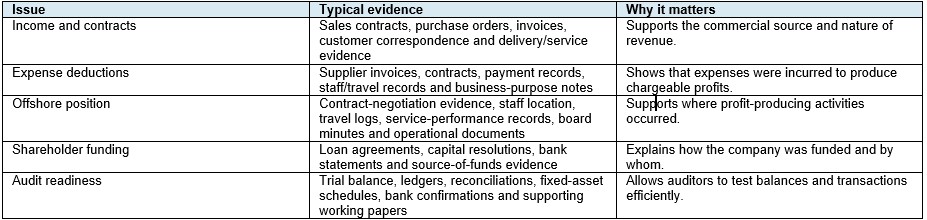
The general deduction principle is that outgoings and expenses are deductible to the extent that they are incurred in producing chargeable profits. Private or domestic expenses, capital expenditure and expenses not incurred to produce profits are not deductible in the same way.
For SME owners, the key point is business purpose. Rent, payroll, professional fees, software subscriptions, travel, bank charges and consultancy costs may be deductible where properly incurred for the company’s business. Personal expenses, unclear shareholder payments, unsupported management charges and capital items require careful review.
Expense planning should not mean pushing every cost through the company. It should mean documenting the business purpose and tax treatment of material costs.
Hong Kong businesses must keep sufficient records of income, expenditure, assets and liabilities so that assessable profits can be readily ascertained. IRD guidance states that such records should generally be retained for at least seven years after the date of the relevant transaction, or until dissolution if earlier for a corporation. Failure to keep sufficient records may result in a fine of up to HK$100,000.
Audit is a separate but connected issue. The Companies Registry explains that audit of financial statements is required for all companies except dormant companies. Reporting exemption may simplify reporting for some qualifying companies, but it should not be confused with a general audit exemption.
This is particularly important for foreign investors from jurisdictions where small private companies often avoid audit. In Hong Kong, audit readiness starts with accurate bookkeeping and document retention during the year.
Filing a Profits Tax Return is not merely completing a form. Active corporations and partnership businesses are generally expected to submit supporting documents, including financial statements and tax computations, where they have gross income during the basis period.
A practical filing package normally includes financial statements, an audit report where required, tax computation, schedules, explanations for material adjustments, bank reconciliations, loan and capital records, and support for any offshore or special positions. The tax computation should explain how accounting profit is adjusted to arrive at assessable profit.
Hong Kong tax administration is moving towards more structured electronic filing. The IRD states that the first phase of mandatory electronic filing of Profits Tax Returns has come into operation. For years of assessment beginning on or after 1 April 2025, specified entities in in-scope multinational enterprise groups are required to file electronically.
This first phase is not a universal mandatory electronic filing obligation for every SME. However, it is a clear signal that tax compliance is becoming more data-driven and document-based. SME owners should use accounting processes capable of supporting electronic records, financial statements, tax computations and supporting schedules.
In practice, many tax problems arise from weak administration rather than deliberate tax planning. Typical mistakes include delaying bookkeeping until year-end, mixing personal and company expenses, claiming an offshore position without evidence, treating revenue as if it were assessable profit, failing to document shareholder loans, and overlooking connected-entity rules for the two-tiered rate.
Other common issues include incomplete bank records, weak contracts, unexplained related-party charges, unclear director or shareholder remuneration, and inconsistencies between the tax file, bank file, accounting records and corporate records.
Eltoma Global can assist with the practical administration of Hong Kong company tax and accounting files, including bookkeeping coordination, audit-readiness support, Profits Tax Return preparation support, document retention checks and liaison with professional advisers. The appropriate scope should be assessed by reference to the company’s activity, ownership structure, transaction profile and regulatory risk.
This support does not imply guaranteed tax treatment, audit outcome, bank acceptance or Inland Revenue Department approval. Each matter depends on the company’s facts and supporting evidence.
For corporations, Hong Kong’s two-tiered Profits Tax regime taxes the first HK$2 million of assessable profits at 8.25% and the balance above HK$2 million at 16.5%. The lower first-tier rate is generally available to only one nominated entity where connected entities are involved.
Hong Kong applies a territorial source principle. Profits arising in or derived from Hong Kong from a trade, profession or business carried on in Hong Kong are chargeable to Profits Tax. Profits sourced outside Hong Kong are generally not taxed, but the source analysis depends on the facts.
No. An offshore profits position should be supported by evidence showing where the profit-producing activities were carried out. Contracts, correspondence, invoices, board records, travel records, staff records and accounting schedules may all be relevant.
A Hong Kong company should not assume that size alone removes the audit requirement. Companies Registry guidance states that audit of financial statements is required for all companies except dormant companies. Reporting exemption may simplify reporting but should not be confused with audit exemption.
A Hong Kong SME should keep sufficient income, expenditure, asset and liability records to allow assessable profits to be readily ascertained. In practice, this means retaining contracts, invoices, bank records, accounting schedules, loan documents, payroll records and support for material tax positions.
No. The first phase of mandatory electronic filing applies to specified entities in in-scope multinational enterprise groups for years of assessment beginning on or after 1 April 2025. However, voluntary electronic filing and iXBRL-ready records show the direction of travel for tax compliance.
Banks, auditors and service providers may review whether a Hong Kong company’s business model, ownership, records and transactions are coherent. A company with organised accounting records and a defensible tax file is usually better prepared for bank reviews, audit and transaction due diligence.
Articles are provided for general informational purposes by an authorised corporate services provider and do not constitute legal advice.

Receive updates with practical insights on international business, law, tax, accounting, and compliance.
Be the first to hear about our latest discounts and special offers!
Follow our Telegram channel for offshore industry news:
Want updates by e-mail?
Enter your email address below to subscribe to our newsletter!