Resources / Knowledge Base
Hong Kong Significant Controllers Register | Eltoma
Practical guide to Hong Kong SCR duties, significant controllers, Form NR2, designated representatives, penalties and bank KYC alignment.

Practical guide to Hong Kong SCR duties, significant controllers, Form NR2, designated representatives, penalties and bank KYC alignment.

Most Hong Kong companies, including companies incorporated in Hong Kong and re-domiciled companies, must maintain a Significant Controllers Register unless an exemption applies. The SCR is not a bank form or a service-provider questionnaire. It is an internal statutory record that identifies persons and legal entities with significant control over the company and must be kept, reviewed, updated and made available for lawful inspection.
The practical consequence is that ownership transparency should not be treated as complete at incorporation. Shareholders and directors may appear in public company records, but the SCR requires a separate review of who ultimately owns, controls or significantly influences the company.
Hong Kong companies are often incorporated quickly, with shareholders and directors recorded at the time of registration. For many business owners, that can create the impression that ownership transparency has already been dealt with once the company is formed. In practice, the obligation goes further.
The Significant Controllers Register, commonly referred to as the SCR, is an internal statutory record of persons and legal entities that have significant control over a Hong Kong company. It is especially relevant where a company is newly incorporated, re-domiciled to Hong Kong, owned through foreign holding companies, administered through nominee arrangements, or placed within a wider group structure.
The important practical point is that the SCR is not a one-time incorporation checklist. It should be treated as a living ownership and control record. The company must identify its significant controllers, enter the required particulars, keep the register up to date and ensure that the register is available when lawfully required.
The Companies Registry explains that the requirement applies to companies formed and registered under the Companies Ordinance or a former Companies Ordinance, and to re-domiciled companies. This includes companies limited by shares, companies limited by guarantee and unlimited companies. Companies with shares listed on The Stock Exchange of Hong Kong are exempt.
The regime therefore affects many ordinary private companies used for trading, holding, consulting, technology, investment and group-administration purposes. A company that has moved its domicile to Hong Kong should also consider the SCR obligation as part of its Hong Kong compliance transition. Existing foreign ownership records may be useful evidence, but they are not a substitute for maintaining the required Hong Kong statutory register.
By contrast, a registered non-Hong Kong company registered under Part 16 of the Companies Ordinance is not generally treated in the same way for this SCR requirement. This distinction matters where a foreign company has registered a Hong Kong place of business but has not become a Hong Kong company.
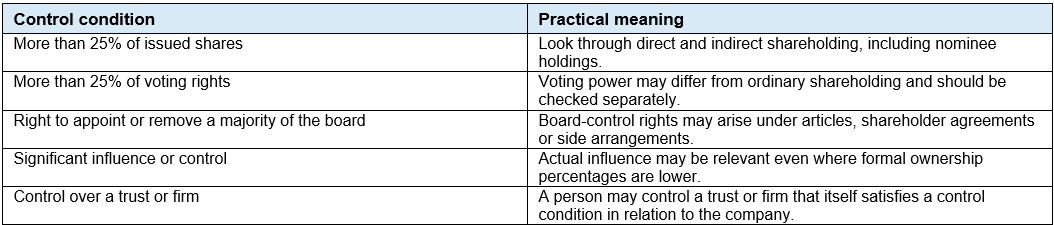
The SCR analysis is not limited to the shareholder register. A person has significant control over a company if one or more statutory control conditions are met.
In broad terms, the conditions cover direct or indirect holding of more than 25% of issued shares; direct or indirect holding of more than 25% of voting rights; the right to appoint or remove a majority of the board; the right to exercise, or actual exercise of, significant influence or control over the company; and significant influence or control over a trust or firm whose trustees or members satisfy one of the control conditions in relation to the company.
For a company without share capital, the test looks at the right to share in more than 25% of the capital or profits. For companies held through trusts, partnerships, nominee shareholders or foreign holding companies, the analysis may require looking beyond the immediate registered shareholder.
The SCR may include a natural person, a specified entity or a registrable legal entity. In practical terms, a natural person with significant control is often the ultimate individual behind the structure. A registrable legal entity is a legal entity that is a member of the company and itself has significant control.
This distinction is important in layered structures. For example, a Hong Kong company may be owned by a corporate shareholder. If that shareholder is itself a legal entity with significant control, it may need to be entered into the SCR. The company may also need to look further through that corporate shareholder to determine whether an individual or another entity has significant control indirectly.
Nominee shareholding does not normally end the enquiry. Companies Registry guidance indicates that a share held by a nominee for another person is regarded as being held by that other person for SCR purposes. The register should therefore reflect the person for whom the shares are held, not merely the nominee who appears in the formal shareholding chain.
A company is required to take reasonable steps to identify its significant controllers. The Companies Registry guidance encourages companies to keep a record of the steps taken. This is a useful practical discipline because the company may need to show that it did more than simply copy the register of members.
Reasonable steps may include reviewing the register of members, articles of association, statement of capital, shareholder agreements, other relevant agreements, trust or nominee documents, joint arrangements, group charts, powers of attorney and board appointment rights. The exact review will depend on the company’s structure.
Where the company knows or has reasonable cause to believe that a person is a significant controller, it must generally give notice to that person within seven days. Where the company believes that another person knows the identity of a significant controller, a notice may also be required. A person receiving an SCR notice must comply with the requirements stated in the notice within one month.
The SCR must contain required particulars. For a natural person, these include name, correspondence address, identity card number or passport number and issuing country, the date on which the person became registrable, and the nature of the person’s control over the company.
For a registrable legal entity, the required particulars include name, registration number or equivalent, registered or principal office address, legal form and governing law, date on which the entity became registrable, and the nature of the entity’s control over the company.
Timing matters. A company must enter the required particulars of a registrable person within seven days after all particulars have been confirmed. For a registrable legal entity, each required particular must be entered within seven days after that particular comes to the company’s notice. The company should also record the nature of control, not merely the name of the controller.
The SCR obligation does not end after the first entry is made. A company must update the register where circumstances change and an existing entry is no longer correct or complete.
Events that should trigger review include a share transfer, issue or redemption of shares, change in voting rights, amendment to a shareholders’ agreement, new nominee or trust arrangement, change in ultimate owner, change in board appointment rights, group reorganisation, re-domiciliation into Hong Kong, bank account opening, or professional adviser review that reveals incomplete ownership information.
If the company knows or has reasonable cause to believe that there is a registrable change, it must generally give notice to the significant controller within seven days. Changes relating to a natural person must be entered within seven days after confirmation, while changes relating to a registrable legal entity must be entered within seven days after the relevant change comes to the company’s notice.
A company must keep its SCR at its registered office or at another place in Hong Kong. The register may be kept in hard copy or electronic form. The practical requirement is that the company must know where the register is kept and be able to make it available when required.
If the SCR is kept somewhere other than the registered office, the company must generally notify the Registrar of Companies of the location using Form NR2 within 15 days after the register is first kept at that place. Notification may not be required in limited situations, for example where the register has always been kept at the registered office or at a previously notified place where the register of members is kept.
This is why SCR maintenance should be coordinated with the company secretary or licensed service provider. The issue is not only who prepares the register, but also where it is kept and whether the location has been properly notified where notification is required.
The SCR must contain the name and contact details of at least one designated representative. The role of the designated representative is to provide assistance relating to the SCR to a law enforcement officer.
The designated representative must be either a member, director or employee of the company who is a natural person resident in Hong Kong, or an accounting professional, legal professional or licensed trust or company service provider. This requirement is particularly important for foreign-owned companies whose directors and shareholders are outside Hong Kong.
Appointing a designated representative should not be treated as a nominal step. The representative should know where the SCR is kept, how the company’s ownership structure is recorded, and who within the company or service-provider team can respond promptly if lawful inspection is requested.
The SCR is not generally filed publicly at incorporation. However, it must be available for inspection by law enforcement officers upon demand. The Companies Registry guidance also explains that a significant controller whose name has been entered in the SCR may inspect the register and obtain copies in the prescribed manner.
Failure to comply with the main SCR obligations is a criminal offence. The company and every responsible person may be liable to a level 4 fine, currently HKD 25,000, and, where applicable, a further daily fine of HKD 700. Knowingly or recklessly making a misleading, false or deceptive statement in the SCR or in a reply to a company notice may lead to more serious penalties.
The SCR should therefore be understood as an enforceable statutory record. It is internal, but it is not optional. It is not a marketing form, bank form or service-provider questionnaire. It is part of the company’s statutory compliance framework.
The SCR, professional intermediary due diligence and bank KYC are related, but they are not the same process.
The SCR is the company’s statutory internal record of significant controllers. Due diligence by a trust or company service provider is the professional intermediary’s own anti-money laundering and counter-terrorist financing process. Bank KYC is the bank’s onboarding and ongoing risk assessment process. The same ownership facts should normally support all three, but each process has its own purpose and requirements.
This is where inconsistent ownership explanations create problems. If the SCR, the company secretary’s due diligence file and the bank account opening file tell different stories, the company may face delays, further questions or regulatory concerns. A complex structure is not necessarily a problem, but it must be capable of being explained and recorded consistently.
Companies with simple ownership may still need a proper SCR, but complex structures require more careful review. Particular attention is needed where there are foreign holding companies, nominee shareholders, trusts, foundations, shareholder agreements, voting arrangements, convertible instruments, options, joint ventures, group reorganisations, or recent movement of the company into Hong Kong.
A practical SCR review should ask: who legally holds the shares; who benefits from the shares; who controls voting; who may appoint or remove directors; who gives binding instructions; whether any trust or nominee arrangement exists; whether any rights are held indirectly; and whether the position is consistent with bank and service-provider information.
The company should retain records showing how it reached its conclusion. This does not mean creating unnecessary paperwork. It means keeping enough evidence to demonstrate that the company considered the actual ownership and control position, not only the face of the share register.
The Significant Controllers Register is a core part of Hong Kong’s beneficial ownership transparency framework. It requires companies to look beyond formal shareholding, identify who has significant control, record the required particulars, keep the register up to date and make it available for lawful inspection.
For newly incorporated companies, re-domiciled companies, foreign-owned groups and structures with nominees or layered ownership, SCR compliance should be treated as an ongoing governance obligation. The register should be reviewed whenever ownership, voting rights, control arrangements or group structures change.
In practical terms, the strongest compliance position is usually the simplest: maintain a clear ownership chart, keep the SCR updated, document reasonable steps taken, align the SCR with service-provider and bank records, and review the position before major changes or transactions.
The Significant Controllers Register is an internal statutory company record used to record persons or legal entities that have significant control over a Hong Kong company. It is not usually filed publicly, but it must be maintained, updated and made available for lawful inspection.
The requirement generally applies to companies incorporated in Hong Kong and re-domiciled companies, including companies limited by shares, companies limited by guarantee and unlimited companies. Listed companies are exempt. Registered non-Hong Kong companies are generally treated differently for this SCR requirement.
A significant controller is a person or legal entity that meets one or more statutory control conditions, such as holding more than 25% of shares or voting rights, having the right to appoint or remove a majority of directors, or exercising significant influence or control.
No. The shareholder register is only the starting point. The SCR analysis may need to look through corporate shareholders, trusts, nominee arrangements, voting rights, shareholder agreements and other control rights to identify the real ownership and control position.
The SCR must be kept at the company’s registered office or another place in Hong Kong. If it is kept somewhere other than the registered office, the company may need to notify the Registrar of Companies using Form NR2 within the prescribed timeline.
The SCR is not generally a public filing document. It must be available for inspection by law enforcement officers upon demand. A significant controller whose name has been entered may also inspect the register and obtain copies in the prescribed manner.
The SCR should be reviewed whenever ownership, voting rights, board appointment rights, nominee arrangements, trust arrangements, group structure or other control facts change. It should also be checked during bank onboarding, service-provider review and major transactions.
The SCR, TCSP due diligence and bank KYC are separate processes, but they should be based on the same ownership facts. Inconsistent explanations across the SCR, service-provider file and bank file can create delays, questions and compliance concerns.

Immigration

Legal Business

Tax

Presentations

Tax Magazines

Guideline Article

Template

Checklist

eBook

Webinar

Our technical content is authored by ELTOMA's senior professionals with deep experience scos corporate services, legal, tax and compñance in international markets.
Speak with our experts about your cross-border
corporate and compliance requirements.
We will respond within one business day.

ELTOMA has been delivering international corporate, tax, and compliance solutions since 2004, helping businesses establish, operate, and grow across key global markets.

Receive updates with practical insights on international business, law, tax, accounting, and compliance.
Be the first to hear about our latest discounts and special offers!
Follow our Telegram channel for offshore industry news:
Want updates by e-mail?
Enter your email address below to subscribe to our newsletter!