

Eltoma Corporate Services — Authorised Corporate Services Provider
Articles are provided for general informational purposes by an authorised corporate services provider and do not constitute legal advice.

A Hong Kong tax compliance calendar should manage more than statutory filing dates. It should coordinate bookkeeping, audit work, tax computation, Employer's Returns, electronic filing, payment planning and record retention so that the company is ready before the Inland Revenue Department deadline arrives. For business owners and finance teams, the practical risk is not only late filing; it is reaching the filing date without accounts, audit evidence, payroll information or supporting schedules capable of substantiating the return.
The correct starting point is workflow. A Hong Kong company should identify when tax returns are issued, when they must be filed, when tax must be paid and which internal steps must be completed before each external deadline. A calendar that records only IRD dates is incomplete if bookkeeping, audit and tax-computation work are not scheduled early enough.
The Inland Revenue Department (IRD) generally issues the main annual business returns at the beginning of April. For the year of assessment 2025/26, the IRD issued approximately 270,000 Profits Tax Returns, 120,000 Property Tax Returns and 340,000 Employer's Returns on 1 April 2026. Taxpayers and employers are generally required to file within one month from the date of issue unless a valid extension arrangement applies.
A practical compliance calendar should therefore have three layers: the issue date of the return, the statutory or extended filing deadline, and the payment date once an assessment or demand note is issued. It should also include internal dates for closing bookkeeping, completing audit work, preparing tax schedules and approving payroll information.
A Profits Tax Return is normally due within one month from its date of issue. Where a tax representative is appointed, the Block Extension Scheme may provide extended filing dates for eligible cases. The precise dates must be checked against the official IRD circular for the relevant year, as they are not static commercial dates.
For the 2025/26 year of assessment, the IRD circular gives the following broad filing positions for Profits Tax Returns under the Block Extension Scheme: no extension for accounting dates from 1 April 2025 to 30 November 2025; 17 August 2026 for accounting dates from 1 December 2025 to 31 December 2025; 16 November 2026 for accounting dates from 1 January 2026 to 31 March 2026; and 1 February 2027 for certain current-year loss cases with accounting dates from 1 January 2026 to 31 March 2026, where the conditions are met.
Commercial tax calendars often simplify these dates. A company should not rely on a generic calendar entry without checking the official IRD Block Extension Scheme circular, confirming whether a tax representative is appointed and confirming that the company falls within the relevant category.
A newly incorporated Hong Kong company should not assume that the absence of a Profits Tax Return means that no tax administration is required. IRD materials state that the first Profits Tax Return is generally issued about 18 months after commencement of a new partnership business or incorporation of a newly incorporated company, although a Provisional Profits Tax Return may be issued earlier where circumstances warrant.
A person chargeable to tax is also required to notify the Commissioner in writing of chargeability within the prescribed period, subject to the position where a return has already been issued or is reasonably expected. In practice, a new company should monitor from its first transaction whether a taxable position has arisen and whether notification may be required.
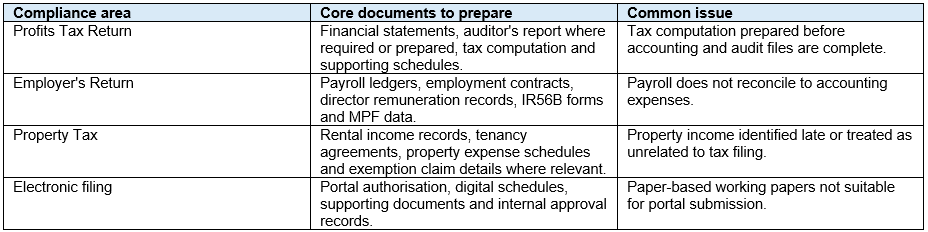
A calendar is useful only if the company is ready to file. Current IRD materials require corporations and partnership businesses with gross income during the basis period to file Profits Tax Returns together with supporting documents, except in specified cases. Supporting documents normally include financial statements, an auditor's report where required or prepared, profit and loss account, tax computation and schedules showing how assessable profits or adjusted losses have been calculated.
The final filing deadline should not be the first time the accounting records are reviewed. Companies should set internal dates for bookkeeping close, audit planning, audit fieldwork, tax computation preparation and director or management approval. If an offshore profits position, capital-gain treatment or another technical tax position is expected, the evidence should be assembled before the return is due.
Hong Kong tax administration is moving further towards digital filing. From the year of assessment 2025/26, the IRD has fully adopted the electronic Block Extension Scheme. Starting from 1 April 2026, tax representatives must submit Block Extension Scheme applications and client notifications electronically through the Tax Representative Portal; paper submission is not allowed.
The first phase of mandatory electronic filing of Profits Tax Returns also came into operation from 1 April 2026 for specified Part 4AA entities of in-scope multinational enterprise groups. Other corporations and businesses are encouraged to e-file, and enhanced electronic filing services allow returns and supporting documents for specified years to be filed through the Business Tax Portal or Tax Representative Portal.
Digital filing changes workflow, not only submission mechanics. Accounts, tax schedules, supporting documents and authorisations should be prepared in a form suitable for electronic filing and portal-based review.
Employer reporting should be built into the same compliance calendar. Employer's Returns of Remuneration and Pensions for the year ended 31 March 2026 were issued on 1 April 2026. Employers are required to complete and file the returns within one month together with Forms IR56B for reporting remuneration paid to employees.
Payroll reporting should reconcile with accounting records, director-remuneration records, employment contracts and any Mandatory Provident Fund (MPF) information. Discrepancies between payroll ledgers, accounting expenses and Employer's Returns can create avoidable questions. Employer reporting is also separate from the employee's own individual tax return.
Property Tax is relevant where a company owns Hong Kong property or receives rental income. Property Tax Returns BIR57 and BIR58 should generally be filed within one month from the date of issue. Where a corporation carrying on business in Hong Kong wishes to apply for exemption from Property Tax under section 5(2)(a) of the Inland Revenue Ordinance, the relevant part of the return should be completed so that the IRD can process the case more efficiently.
MPF is not a Profits Tax filing, but it belongs in the operational calendar for employers. The Mandatory Provident Fund Schemes Authority states that, for monthly-paid employees, the contribution day is generally the 10th day of each month. Payroll, MPF and Employer's Return records should therefore be managed as connected compliance information.
A tax calendar should not end with filing. The company also needs to monitor IRD assessments, payment deadlines and provisional tax. Payment dates are set by the assessment or demand note, and provisional tax may create a cash-flow requirement before final tax for the next year is known.
Finance teams should build a process for reviewing assessments promptly, checking whether the figures agree with the filed return, considering any objection or holdover position where appropriate, and ensuring that payment instructions are scheduled before the due date.
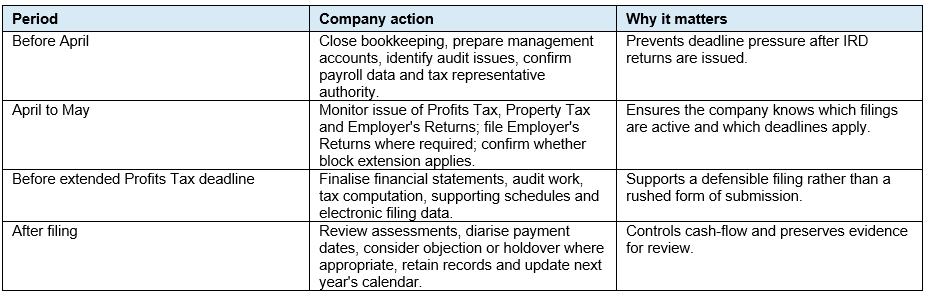
A practical Hong Kong tax calendar should be organised around workflow rather than dates alone. Before April, the company should close bookkeeping, prepare management accounts, identify audit issues, confirm tax representative authorisation and prepare payroll data. In April and May, it should monitor return issue, confirm whether block extension applies, file Employer's Returns and identify any Property Tax reporting requirement.
Before the extended Profits Tax deadline, the company should finalise accounts, complete audit work, prepare the tax computation, gather supporting schedules, prepare electronic filing data where relevant and obtain internal approval. After filing, it should monitor assessments, plan payment, retain records and update the next year's calendar.
Eltoma Global can assist with Hong Kong company bookkeeping coordination, audit timetable planning, Profits Tax Return support, tax computation preparation, Employer's Return coordination and annual compliance review. The assistance should be scoped by reference to the company's activity, records, audit position, tax representative arrangements and filing deadlines.
A Hong Kong tax compliance calendar should be used as a management tool, not merely as a deadline reminder. It should coordinate bookkeeping, audit, tax computation, payroll reporting, electronic filing, payment planning and record retention.
Companies that prepare early usually reduce filing pressure, avoid preventable errors and give advisers enough time to resolve technical issues before deadlines arise. Deadline discipline is therefore not only an administrative matter. It is part of running a Hong Kong company in a credible, bankable and professionally managed way.
This article is for general information only and should not be treated as legal, tax or accounting advice. Filing dates, electronic filing scope and tax positions should be checked against current official materials before publication or client use.
The IRD generally issues the main annual business returns at the beginning of April. For the 2025/26 year of assessment, Profits Tax, Property Tax and Employer's Returns were issued on 1 April 2026. A company should still confirm whether a specific return has been issued to it and whether any extension arrangement applies.
No. The Block Extension Scheme is relevant where a tax representative is appointed and the case falls within the applicable IRD extension category. The dates are year-specific and should be checked against the official IRD circular for the relevant year before any filing date is relied on.
No. A new company should maintain accounting records from its first transaction and monitor whether it has become chargeable to tax. The first Profits Tax Return is generally issued about 18 months after incorporation or commencement, but earlier tax administration or notification issues may arise.
An active Hong Kong company normally needs financial statements, an auditor's report where required or prepared, a tax computation and supporting schedules. Additional evidence may be required where the company takes an offshore profits position, capital-gain position or another technical tax position.
Not for all companies at this stage. The first phase of mandatory electronic filing applies to specified Part 4AA entities of in-scope multinational enterprise groups for years of assessment beginning on or after 1 April 2025. Other businesses are encouraged to use e-filing where available.
Yes. Employer's Returns are separate from Profits Tax, but they should be managed in the same compliance calendar. Payroll data should reconcile with accounting records, director remuneration records, employment contracts and MPF information where applicable.
Filing is not the end of the process. After the IRD issues an assessment or demand note, the company must review the figures, consider any objection or holdover position where appropriate, and pay by the due date. Provisional tax may also create a cash-flow requirement.
Articles are provided for general informational purposes by an authorised corporate services provider and do not constitute legal advice.

Receive updates with practical insights on international business, law, tax, accounting, and compliance.
Be the first to hear about our latest discounts and special offers!
Follow our Telegram channel for offshore industry news:
Want updates by e-mail?
Enter your email address below to subscribe to our newsletter!