

Eltoma Corporate Services — Authorised Corporate Services Provider
Articles are provided for general informational purposes by an authorised corporate services provider and do not constitute legal advice.

Singapore remains one of Asia’s most attractive locations for regional headquarters, technology businesses, international trading groups, family offices and investment platforms. Its commercial appeal, however, can lead founders to treat company registration as though it were an immigration programme. That is a fundamental mistake.
A foreign investor may own shares in a Singapore company, but every local company must have at least one director who satisfies the local-residency requirement. A foreigner who wishes to move to Singapore and actively run the business requires an appropriate work pass. The use of a local resident director, a registered office or a corporate service provider does not give the overseas shareholder permission to work in Singapore.
The same distinction applies to visitors. A Short-Term Visit Pass may permit business meetings, discussions with professional advisers and certain other limited activities, but it does not authorise a founder to manage the company from Singapore on an ongoing basis. Immigration status, corporate ownership, employment authority and tax residence are separate questions and should be treated as separate workstreams.
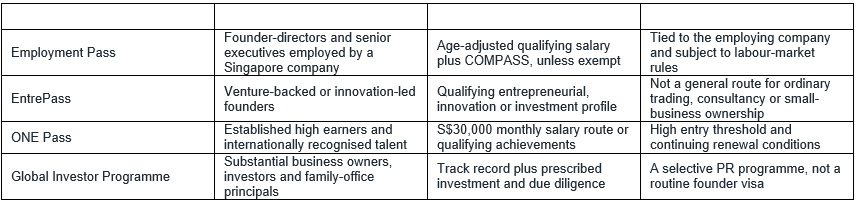
For many established businesses, the Employment Pass (EP) is the most practical route. The Singapore company applies as employer for the founder or shareholder in a genuine managerial or executive role. Share ownership does not prevent an EP application, but it does not create an entitlement to approval. The application must still demonstrate a credible position, appropriate remuneration and a real Singapore business.
As at July 2026, the minimum EP qualifying salary starts at S$5,600 per month outside financial services and S$6,200 in financial services. The threshold rises progressively with age. For new applications from 1 January 2027, the starting figures will increase to S$6,000 and S$6,600 respectively, with higher age-adjusted amounts. A founder who budgets only for the published minimum may therefore underestimate both the age-based threshold and the salary level needed to score under COMPASS.
Unless exempt, the candidate must also pass the Complementarity Assessment Framework (COMPASS) with at least 40 points. COMPASS considers the candidate’s salary and qualifications, together with the employer’s nationality diversity and support for local employment, and may award bonus points in specified circumstances. Very highly paid candidates, qualifying overseas intra-corporate transferees and certain short-term roles are exempt from COMPASS.
The Fair Consideration Framework normally requires the vacancy to be advertised on MyCareersFuture for at least 14 consecutive days before the EP application. Companies with fewer than ten employees are exempt from the advertising requirement, as are certain highly paid, short-term and transfer roles; however, fair hiring obligations still apply. A founder should not assume that describing a position as “Managing Director” removes the need to consider the applicable employment rules.
For a newly incorporated or owner-controlled company, the quality of the underlying business case is particularly important. The structure should be capable of explaining the company’s capital, contracts, premises, customer pipeline, staffing plan, founder’s experience, proposed salary and commercial reason for locating the role in Singapore. The EP should be the immigration expression of a genuine operating plan, not the sole purpose for which the company was created.
The EntrePass is often described too broadly as Singapore’s “entrepreneur visa”. In its present form, it is a targeted route for serial entrepreneurs, high-calibre innovators and experienced investors who intend to operate a venture-backed business or one possessing innovative technology.
The applicant may propose or establish an ACRA-registered private company and, where the company is already registered, must hold at least 30% of its shares. If the company is more than 12 months old when the application is made, it is assessed against renewal-style criteria. The applicant must also satisfy at least one specified profile condition, such as qualifying fundraising, support from a recognised incubator or accelerator, a successful technology-business exit, qualifying intellectual property, research collaboration in Singapore or relevant investment experience.
There is no stipulated minimum salary for the EntrePass. That does not make it a lower-cost substitute for the EP. The decisive question is whether the founder and the venture fit the innovation policy behind the route. A conventional consultancy, restaurant, import-export company or general e-commerce business will not become eligible merely because its owner prefers the EntrePass.
Renewal is tied to business development. The pass holder must retain at least 30% ownership, demonstrate ongoing business activity and progress, provide financial statements and meet progressively increasing total business spending and local workforce requirements. From the second renewal cycle, the published benchmark begins at annual total business spending of S$100,000 and one local workforce member, rising in later cycles. The migration plan must therefore include a credible Singapore growth plan from the outset.
The Overseas Networks & Expertise Pass, commonly known as the ONE Pass, is materially different from both the EP and EntrePass. It is designed for top talent and high earners and can be particularly useful to an established founder who intends to operate, invest in or work for more than one Singapore company.
The principal salary route generally requires fixed monthly remuneration of at least S$30,000 for the 12 consecutive months before application, or prospective employment at that level with an established Singapore company. Where relevant, an established company must ordinarily meet the published market-capitalisation or annual-revenue threshold. A separate route is available for outstanding achievements in specified fields.
The pass may be granted for up to five years and allows the holder to start, operate and work for multiple companies without applying for a new pass each time. It is also exempt from COMPASS and the Fair Consideration Framework advertising requirement. This flexibility can be valuable for a founder with several ventures, board roles or investment activities.
The threshold is deliberately high. Renewal requires either an average fixed monthly salary of at least S$30,000 over the preceding five years in Singapore or the operation of a Singapore company employing at least five locals, each earning at least the prevailing EP minimum qualifying salary. The ONE Pass should therefore be viewed as a route for an already established international profile, not as a general startup solution.
The Global Investor Programme (GIP), administered by Contact Singapore within the Economic Development Board, is not a work pass. It is a selective pathway to Singapore permanent residence for applicants with a substantial business track record and successful entrepreneurial or investment background.
The programme recognises several profiles, including established business owners, next-generation business owners, founders of fast-growth companies and family-office principals. The eligibility thresholds are substantial. By way of example, an established business owner is generally expected to have at least three years of entrepreneurial experience and to be running a qualifying company with annual turnover of at least S$200 million, subject to the detailed conditions.
Current investment options include at least S$10 million in a new or expanded Singapore business, S$25 million in a GIP-select fund, or the establishment of a Singapore-based single family office with at least S$200 million in assets under management, of which at least S$50 million must be transferred to Singapore and deployed into prescribed investments. Applications are subject to an interview, extensive documentation and due diligence.
The GIP should not be marketed as a simple “investment visa”. It is an economic-contribution programme with ongoing conditions, including investment implementation and re-entry permit requirements. It may be highly relevant to a substantial entrepreneur or family-office principal, but it is not designed for the ordinary owner-managed company.
Two routes deserve particular caution. First, an S Pass is not an owner-management solution: MOM states that S Pass and Work Permit holders are not permitted to own or manage a Singapore business or act as company directors. Secondly, the Personalised Employment Pass offers flexibility between employers but expressly does not permit the holder to start a business or conduct entrepreneurial activity. A business owner considering the PEP should instead examine whether the EntrePass, ONE Pass or an EP through the Singapore company is appropriate.
Family planning should be addressed before the principal application, not after relocation. An EP holder earning at least S$6,000 per month may generally sponsor a legally married spouse and unmarried children under 21 for Dependant’s Passes. Common-law spouses, certain stepchildren and certain adult disabled children may qualify for Long-Term Visit Passes. Parents may be sponsored only where the EP holder earns at least S$12,000 per month.
EntrePass family eligibility follows different rules. Bringing a spouse and children ordinarily requires either specified business spending and local workforce levels or one of the published founder-profile alternatives. Parents require higher business spending and local employment. ONE Pass holders benefit from broader family arrangements, including the ability of an eligible spouse to seek a Letter of Consent to work.
A Dependant’s Pass is a residence permission, not a general work authorisation. A dependant who wishes to take employment will normally require an appropriate work pass. There is, however, a specific Letter of Consent route for a Dependant’s Pass holder who genuinely operates an ACRA-registered business as a sole proprietor, partner or company director holding at least 30% of the company. Renewal requires, among other matters, at least one Singapore citizen or permanent resident employee meeting the prevailing local salary and CPF conditions.
An EP or S Pass holder may apply separately to the Immigration & Checkpoints Authority for permanent residence. Approval is discretionary. ICA considers factors including family ties, economic contributions, qualifications, age, family profile, length of residence and the applicant’s ability to integrate and demonstrate commitment to Singapore. A work pass is therefore a possible platform for a later PR application, not a promise of PR.
Immigration residence must also be distinguished from tax residence. A founder may become Singapore tax resident by reference to the applicable presence and employment rules, while continuing to have tax connections elsewhere. The Singapore company’s tax residence depends on where its control and management are exercised. Moving the shareholder, obtaining a pass and incorporating a company do not automatically settle personal tax residence, corporate residence, permanent-establishment exposure or the treatment of income from other jurisdictions.
For business owners from third countries, including Russia, Ukraine and China, banking and immigration planning should also be coordinated with source-of-wealth evidence, sanctions screening, beneficial-ownership disclosure and the expected payment geography. Nationality alone is not the legal test, but the ownership chain, source of capital, counterparties and transaction routes may lead to enhanced due diligence by banks and professional service providers.
Singapore offers several credible immigration routes for business owners, but no single pass is suitable for every founder. The EP is generally the mainstream option for an owner-executive employed by a genuine Singapore business. The EntrePass is narrower and innovation-led. The ONE Pass serves established global talent requiring flexibility across several ventures. The GIP is a selective permanent-residence programme for substantial investors and business families.
The strategic lesson is the same as in corporate structuring more generally: the application should follow the business model, not the other way around. A sound relocation project aligns the founder’s immigration status with the company’s real functions, local substance, employment plan, family needs, banking profile and tax position. Incorporation may take days; building an immigration and operating structure capable of surviving regulatory, banking and tax scrutiny requires considerably more planning.
No. Company ownership and immigration permission are separate. A foreign shareholder may own a Singapore company, but a person who intends to live in Singapore and actively manage or work for the business requires an appropriate work pass. The company must also maintain the required local-residency arrangements.
For an owner-executive employed in a genuine managerial or executive role by a Singapore company, the Employment Pass is usually the mainstream route. EntrePass is narrower and innovation-led, ONE Pass serves established high earners or recognised talent, and GIP is a selective permanent-residence programme for substantial investors.
Yes. Share ownership does not prevent an Employment Pass application, but it does not create an entitlement to approval. The application should demonstrate a genuine role, qualifying salary, a credible Singapore business, appropriate capital and operations, and compliance with COMPASS and fair-hiring requirements where applicable.
As at July 2026, the starting minimum is S$5,600 per month outside financial services and S$6,200 in financial services, with higher age-adjusted thresholds. For new applications from 1 January 2027, the starting figures increase to S$6,000 and S$6,600 respectively. Meeting the minimum does not by itself guarantee approval.
The Employment Pass is an employer-sponsored route for qualifying professional, managerial or executive employment and is commonly used by genuine owner-executives. EntrePass is designed for venture-backed or innovative businesses and requires a qualifying founder, innovation or investment profile rather than ordinary entrepreneurship.
The ONE Pass provides materially greater flexibility than an employer-specific Employment Pass and may allow the holder to start, operate and work for multiple companies without a new pass for each role. The applicant must first satisfy the high entry criteria and later meet the renewal conditions.
No. The Global Investor Programme is a selective pathway to Singapore permanent residence for qualifying substantial business owners, investors and family-office principals. It requires a strong track record, prescribed investment, extensive due diligence and continuing economic-contribution conditions.
A Dependant’s Pass does not generally provide unrestricted work rights. The spouse will normally need an appropriate work pass. A qualifying Dependant’s Pass holder who genuinely operates an ACRA-registered business may apply for the specific business-owner Letter of Consent, subject to the prevailing conditions.
No. An eligible work-pass holder may apply for permanent residence, but ICA assesses the application separately and approval is discretionary. A work pass may provide a platform for a later application, but it is not a promise of permanent residence.
No. Personal tax residence and corporate tax residence are separate legal questions. IRAS applies presence and employment rules to the individual, while a company is generally Singapore tax resident when its control and management are exercised in Singapore. Other jurisdictions may also retain taxing rights or permanent-establishment claims.
Articles are provided for general informational purposes by an authorised corporate services provider and do not constitute legal advice.

Receive updates with practical insights on international business, law, tax, accounting, and compliance.
Be the first to hear about our latest discounts and special offers!
Follow our Telegram channel for offshore industry news:
Want updates by e-mail?
Enter your email address below to subscribe to our newsletter!