

Eltoma Corporate Services — Authorised Corporate Services Provider
Articles are provided for general informational purposes by an authorised corporate services provider and do not constitute legal advice.

Introduction: transparency after incorporation
In the earlier articles in this series, we considered why incorporation is only the beginning of a Singapore company’s compliance life and why the local resident director should be understood as a governance appointment rather than a purely administrative name on the register. The next logical question is ownership and control: after the company is incorporated and its officers are appointed, can the company demonstrate who owns it, who controls it and whether any person is acting as a nominee for another party?
This question is particularly important for foreign-owned Singapore companies. A simple ACRA business profile may show the registered shareholder and the appointed directors. It may not, by itself, explain the complete ownership chain, the ultimate beneficial owner, the person who gives instructions behind a nominee arrangement, or the individual who exercises significant control through contractual or corporate rights.
Singapore’s transparency framework therefore requires companies to maintain statutory records that go beyond ordinary company administration. These records are relevant not only to ACRA compliance, but also to corporate service provider onboarding, bank account opening, periodic bank reviews, audit, tax administration, investor due diligence and responsible corporate governance.
Why ownership and nominee records matter
The policy behind beneficial ownership and nominee registers is straightforward: a company should not be capable of being used as an opaque vehicle where ownership, control or nominee arrangements cannot be properly identified. Transparency records help reduce the risk of misuse of companies for money laundering, terrorism financing, proliferation financing, sanctions evasion, fraud or other unlawful purposes.
In practical terms, the same records also support ordinary commercial credibility. Banks, auditors, tax advisers, investors and corporate service providers frequently need to reconcile four separate layers of information: the company’s ACRA profile, its internal statutory registers, its KYC file and its banking or transaction documents. Where those records are inconsistent, outdated or incomplete, a routine compliance review can become a significant obstacle.
For a foreign-owned company, this is often where difficulties arise. A company may be properly incorporated, but the bank may still ask who ultimately owns a corporate shareholder. A nominee shareholder may be shown as the registered shareholder, but the bank may ask who gives voting instructions or receives the economic benefit. A nominee director may be formally appointed, but the corporate service provider may need to understand the nominator and the business rationale behind the arrangement.
The three core transparency registers
For most private companies, the practical transparency framework can be understood through three core registers. They are separate records and should not be treated as interchangeable.
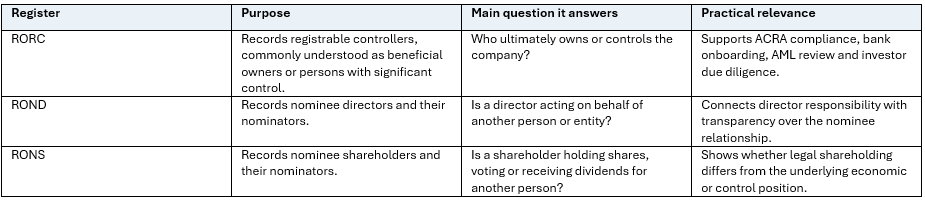
The Register of Registrable Controllers, commonly referred to as the RORC, is intended to identify persons or legal entities with significant ownership or significant control over the company. It is often described in business language as the beneficial ownership register, although the legal analysis is more precise than a simple search for the person who receives profits.
For a company with share capital, significant interest will commonly arise where a person or legal entity has an interest in more than 25% of the shares or shares carrying more than 25% of the total voting power. Significant control may arise where a person has rights to appoint or remove directors who hold a majority of voting rights at board meetings, holds more than 25% of voting rights on matters requiring member approval, or otherwise exercises significant influence or control over the company.
The key point for business owners is that the RORC is not merely a copy of the shareholder register. It should identify who ultimately owns or controls the company, including through indirect ownership chains or control rights. A shareholder may be a company, trustee, nominee or holding vehicle. The RORC analysis asks whether there is another person or legal entity behind that registered position who must be recorded as a controller.
ACRA will not identify a company’s controllers for it. The company must take reasonable steps to identify them, issue the necessary notices, maintain the private register and file the required information with ACRA’s Central RORC, unless exempt. This is why beneficial ownership review should be built into the company’s ongoing compliance calendar rather than treated as a one-off incorporation task.
The Register of Nominee Directors and Register of Nominee Shareholders address a different but related question. They do not simply ask who owns or controls the company. They ask whether a director or shareholder is acting for, or on behalf of, another person or entity.
A nominee director is a person who acts as director on behalf of another person or entity, known as the nominator. This does not remove the fact that the nominee director remains a director of the company. It does, however, mean that the nominee relationship should be identified and recorded. This is important because director responsibility and nominee transparency must be considered together.
A nominee shareholder may be a shareholder who votes according to another person’s instructions or receives dividends on behalf of another person. In such cases, the person shown as shareholder may not be the person who economically benefits from, or ultimately controls, the shares. The RONS helps document that distinction.
Nominee arrangements may be legitimate and commercially useful, especially in cross-border structures. However, they should not be undocumented private arrangements. A responsible company and its corporate service provider should be able to explain who the nominee is, who the nominator is, what the commercial purpose of the arrangement is, and whether the arrangement is consistent with the company’s KYC and AML profile.
A common misconception is that keeping an internal file is enough. In Singapore, the transparency framework operates through both private registers and central filings with ACRA. The private registers form part of the company’s statutory records and may be kept in physical or electronic form at the registered office or at the office of the company’s corporate service provider, where appropriate.
The company must maintain its private RORC, ROND and RONS, unless exempt. Separately, it must file the relevant information or updates with the applicable central registers maintained by ACRA. The Central RORC has been a filing requirement for companies that must maintain an RORC. The Central ROND and Central RONS filing requirement applies to companies and foreign companies unless exempt, and companies incorporated from 16 June 2025 file relevant information during registration through Bizfile.
This division between private registers and central registers matters in practice. The private file should contain the company’s working record and supporting documents. The central filing ensures that the regulator has access to the relevant beneficial ownership and nominee information for law enforcement and regulatory purposes. The two records should be consistent.
The information required is not merely a name and contact number. For individual controllers or nominators, records may include full name, aliases, residential address, email address, contact number, nationality, identity card or passport details, date of birth and the dates on which the person became or ceased to be a controller, nominee or nominator. For corporate controllers or corporate nominators, the information usually includes the entity name, registration number, registered office address, legal form, jurisdiction of formation or registration and relevant dates.
For foreign-owned companies, supporting documentation is often just as important as the register entry itself. The compliance file may need copies of passports, certificates of incorporation, registers of members, ownership charts, constitutional documents, board or shareholder resolutions, nominee agreements, trust or agency documents and evidence explaining how control is exercised.
These records should be maintained carefully and updated promptly. They are statutory transparency records and should not be prepared as generic contact lists. If the company later opens a bank account, undergoes a bank review, changes its shareholder structure or admits a new investor, inaccurate register information can delay the transaction or undermine the company’s compliance credibility.
Foreign shareholders often ask whether beneficial ownership and nominee information is publicly available. The answer requires some care. ACRA states that the public can access company registers except the RORC, ROND and RONS. The Central RORC is not publicly available and is used for law enforcement and regulatory purposes.
For nominee information, the position is more nuanced. Current nominee status of a director or shareholder may appear in the company’s Business Profile once the information is filed, meaning that counterparties may be able to see that a person is acting as a nominee. However, the identity and particulars of the nominator are not generally made publicly available. This distinction is important: nominee status may be visible, but the underlying nominator details remain protected from ordinary public search.
Even where information is not public, it should still be accurate and complete. Banks, regulators, auditors and corporate service providers may request supporting evidence as part of their own duties. Confidentiality does not remove the obligation to maintain proper records.
Transparency obligations are not one-time incorporation filings. They require continuing maintenance. For the RORC, a company must update its private register after the controller confirms a change, and changes must then be filed with the Central RORC within the applicable filing timeline. Companies should also send notices to registrable controllers at least once a year to verify their details.
For ROND and RONS, companies must update private registers when nominee status changes or a nominator’s particulars change, and then file the update with the Central ROND and Central RONS within the prescribed period after updating the private register. Companies should therefore establish a practical compliance trigger: whenever there is a change in ownership, control, directorship, shareholding, nominee status, passport details, address, corporate shareholder or group structure, the transparency registers should be reviewed.
A well-managed company will not wait until annual return season or a bank request before reviewing these records. The better approach is to integrate RORC, ROND and RONS checks into onboarding, annual compliance review, share transfers, director changes, nominee appointments, bank account opening, financing transactions and restructuring projects.
In practice, foreign-owned Singapore companies most often encounter difficulties in the following areas:
multi-layer corporate ownership where the ultimate individual beneficial owner is several entities above the Singapore company;
foreign holding companies whose internal registers are not updated or are not readily available in English;
shareholders holding shares for family members, business partners, trusts or investment arrangements;
nominee shareholder arrangements that are not supported by written agreements or disclosure documents;
nominee director arrangements where the nominator, authority limits and reporting obligations are not clearly recorded;
bank KYC information that does not match the company’s private registers or ACRA filings;
changes of passport, address, citizenship, company name or ownership that are not notified to the corporate service provider;
use of dormant or inactive companies without maintaining statutory records.
These issues are usually manageable if they are identified early. They become significantly more difficult when they are discovered during bank onboarding, investor due diligence, audit finalisation, a share sale or a regulatory review. A foreign-owned company should therefore treat ownership and nominee records as part of its operating infrastructure, not as documents prepared only when requested.
Banks and corporate service providers are required to understand the customer, the ownership and control structure, the persons connected to the company and the commercial rationale for the relationship. This is why beneficial ownership and nominee records are often requested at the earliest stage of bank account opening or CSP onboarding.
A professional TCSP should help the company identify which records are required, collect the necessary information, maintain private registers, coordinate central filings and check that the company’s ACRA records, internal registers and KYC file are aligned. This is governance and risk management work, not merely secretarial administration.
For a foreign-owned Singapore company, transparent ownership records improve bankability, audit readiness and transaction readiness. They also reduce the risk that a routine compliance request becomes urgent because the company cannot quickly explain who owns or controls it.
Identify all direct and indirect shareholders and controllers.
Check whether any person has significant control even without majority share ownership.
Maintain a private RORC unless exempt and file required information with ACRA’s Central RORC.
Identify whether any director acts as a nominee and maintain the ROND where required.
Identify whether any shareholder acts as a nominee and maintain the RONS where required.
File ROND and RONS information or changes with the central registers where required.
Keep supporting documents, not only register entries.
Send annual notices to registrable controllers and document responses.
Notify the CSP promptly when ownership, control or nominee arrangements change.
Review registers before bank onboarding, share transfers, director changes, investor due diligence or restructuring.
Beneficial ownership and nominee registers are now central to the administration of Singapore companies. They should not be treated as secondary documents completed after incorporation and forgotten. For foreign-owned companies, they are an essential part of demonstrating transparency, governance discipline and compliance readiness.
The practical message is simple: a company should know who its shareholders and directors are, but it should also know who ultimately owns or controls the company and whether any person is acting as a nominee. Accurate RORC, ROND and RONS records help protect the company, its directors, shareholders, corporate service provider and banking relationships.
A properly managed TCSP does not merely maintain forms. It helps the company build a reliable ownership and nominee record, aligned with Singapore’s corporate transparency framework and suitable for real-world banking, audit, tax and investor due diligence.
For corporations, Hong Kong’s two-tiered Profits Tax regime taxes the first HK$2 million of assessable profits at 8.25% and the balance above HK$2 million at 16.5%. The lower first-tier rate is generally available to only one nominated entity where connected entities are involved.
Hong Kong applies a territorial source principle. Profits arising in or derived from Hong Kong from a trade, profession or business carried on in Hong Kong are chargeable to Profits Tax. Profits sourced outside Hong Kong are generally not taxed, but the source analysis depends on the facts.
No. An offshore profits position should be supported by evidence showing where the profit-producing activities were carried out. Contracts, correspondence, invoices, board records, travel records, staff records and accounting schedules may all be relevant.
A Hong Kong company should not assume that size alone removes the audit requirement. Companies Registry guidance states that audit of financial statements is required for all companies except dormant companies. Reporting exemption may simplify reporting but should not be confused with audit exemption.
A Hong Kong SME should keep sufficient income, expenditure, asset and liability records to allow assessable profits to be readily ascertained. In practice, this means retaining contracts, invoices, bank records, accounting schedules, loan documents, payroll records and support for material tax positions.
No. The first phase of mandatory electronic filing applies to specified entities in in-scope multinational enterprise groups for years of assessment beginning on or after 1 April 2025. However, voluntary electronic filing and iXBRL-ready records show the direction of travel for tax compliance.
Banks, auditors and service providers may review whether a Hong Kong company’s business model, ownership, records and transactions are coherent. A company with organised accounting records and a defensible tax file is usually better prepared for bank reviews, audit and transaction due diligence.
Articles are provided for general informational purposes by an authorised corporate services provider and do not constitute legal advice.

Receive updates with practical insights on international business, law, tax, accounting, and compliance.
Be the first to hear about our latest discounts and special offers!
Follow our Telegram channel for offshore industry news:
Want updates by e-mail?
Enter your email address below to subscribe to our newsletter!