

Eltoma Corporate Services — Authorised Corporate Services Provider
Articles are provided for general informational purposes by an authorised corporate services provider and do not constitute legal advice.

Singapore private companies must treat corporate tax compliance as a separate IRAS process, not as part of the ACRA annual return. The core annual workflow normally includes bookkeeping, management accounts, Estimated Chargeable Income (ECI), a tax computation and the annual corporate income tax return through Form C-S, Form C-S (Lite) or Form C. Timely records are essential because tax filing, audit, banking and investor due diligence all rely on the same financial evidence.
A Singapore company should monitor two connected but separate compliance tracks. ACRA annual return filing confirms the company’s corporate registry information. IRAS corporate income tax filing reports the company’s taxable position. A company may complete its annual return, update its officers and file financial statements or XBRL where required, but still have separate tax obligations with IRAS.
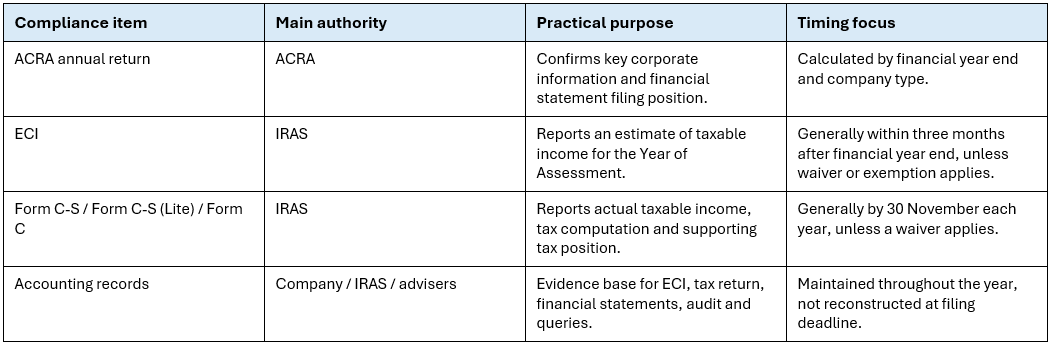
Singapore corporate income tax is assessed on a preceding-year basis. In practical terms, the Year of Assessment relates to income earned in the preceding financial year or basis period. A company with a financial year ending on 31 December 2025 would generally report that financial year in the following Year of Assessment. Companies with non-calendar financial year ends should check the correct basis period and related deadlines carefully.
The general Singapore corporate income tax rate is 17% of chargeable income. The final tax payable is not calculated simply by applying 17% to accounting profit. The company must first prepare a tax computation that adjusts accounting profit or loss for tax purposes. Depending on the company’s circumstances, this may involve non-deductible expenses, non-taxable income, capital allowances, unutilised losses, foreign exchange items, related-party balances and other specific tax issues.
For most private companies, corporate income tax compliance has two principal filings. The first is Estimated Chargeable Income, commonly referred to as ECI. The second is the annual corporate income tax return, filed through Form C-S, Form C-S (Lite) or Form C depending on the company’s eligibility and tax profile.
These filings are related, but they are not the same. ECI is an estimate of taxable income. The annual return to IRAS reports the company’s actual taxable income for the relevant Year of Assessment and should be supported by a tax computation and underlying records.
ECI is an estimate of the company’s taxable income for a Year of Assessment. It is generally filed within three months after the end of the company’s financial year, unless the company qualifies for an ECI filing waiver or is specifically not required to file. ECI should not be treated as a rough guess. It should be supported by management accounts or properly prepared financial information.
A responsible ECI review should consider whether the company generated revenue, incurred deductible expenses, recorded non-deductible costs, may claim capital allowances, has losses or has any unusual items that need tax analysis. In practice, bookkeeping should be substantially up to date shortly after the financial year end.
A poorly supported ECI position can create practical problems. IRAS may issue an estimated assessment if ECI is late or not filed where required. A material difference between ECI and the final chargeable income reported later may also lead to follow-up questions. For companies seeking bank financing, investor funding or group reporting consistency, unreliable ECI reporting can weaken the company’s compliance profile.
Some companies may qualify for an ECI filing waiver or may not be required to file ECI in specific circumstances. This should be checked each year and should not be assumed merely because the company is small, newly incorporated, inactive or loss-making.
A company may have no revenue but still have expenses, assets, loans, bank movements or intercompany balances. It may also have incurred pre-trading costs or received income that needs classification. The question is not simply whether sales invoices were issued. The company should assess its actual financial position and document why ECI is or is not required.
The annual corporate income tax return is filed separately from ECI. Singapore companies may file Form C-S, Form C-S (Lite) or Form C depending on eligibility. Form C-S is a simplified return for qualifying companies. Form C-S (Lite) is a further simplified version for qualifying companies with straightforward tax matters. Form C is the full return and is generally more detailed.
The correct form should not be selected casually. A company must consider whether it satisfies the relevant eligibility criteria and whether its tax affairs are sufficiently straightforward. Where there are group transactions, related-party balances, foreign income, tax incentives, capital allowances, carried-forward losses or other items requiring detailed support, the tax position should be reviewed carefully.
Where Form C is required, companies should expect to submit financial statements, tax computation and supporting documents. Even where Form C-S or Form C-S (Lite) is available, the company should still prepare and retain the documents supporting the figures submitted, because IRAS may request them.
Corporate tax filing cannot be prepared properly from a bank balance alone. A Singapore company should maintain books and records that explain its income, expenses, assets, liabilities and transactions. For a private company, this commonly includes bank statements, sales invoices, supplier invoices, contracts, payroll records, loan agreements, intercompany schedules, fixed asset records, expense receipts, management accounts and foreign exchange support where relevant.
Bookkeeping is the evidential basis for tax compliance. Without proper records, the company may not be able to determine whether income is taxable, whether expenses are deductible, whether certain payments should be capitalised, whether related-party balances are correctly recorded or whether tax adjustments are required.
IRAS record-keeping guidance requires companies to retain source documents, accounting records and schedules, bank statements and other relevant transaction records for at least five years from the relevant Year of Assessment. Good record keeping is therefore not only a tax filing convenience; it is a statutory and risk-management discipline.
Management accounts help the company understand its financial position before filing deadlines arise. They support ECI filing, tax planning, director review, bank reporting and business decision-making.
A tax computation performs a different function. It starts from accounting profit or loss and adjusts it to determine taxable income. This may involve adding back non-deductible expenses, excluding non-taxable income, claiming capital allowances, considering prior-year losses, reviewing private or non-business expenses, analysing foreign exchange differences and checking related-party transactions.
This is where accounting and tax analysis meet. For example, an expense may be correctly recorded for accounting purposes but may not be deductible for tax purposes. Accounting depreciation may need to be adjusted, with capital allowances considered separately. Shareholder loans, director expenses, intercompany service fees and overseas payments may also require closer analysis.
Dormant and inactive companies require careful treatment. A company that has not traded may still have expenses, a bank account, shareholder funding, assets, liabilities or maintenance costs. These matters should be reviewed before assuming that no tax action is required.
A dormant company may be eligible for simplified treatment or waiver in certain circumstances, but the basis for that conclusion should be documented. Dormant status should not be assumed merely because there are no customers or no revenue. Inactivity should be reviewed, documented and monitored.
Although ACRA and IRAS filings are separate, the information used for corporate and tax compliance should be consistent. The financial year end is particularly important because it affects the basis period for tax, the ECI deadline, annual return timing and financial statement preparation.
Other company particulars should also be aligned. Registered address, company name, business activity, directors and authorised persons may affect correspondence, filing access and practical compliance management. If ACRA records, accounting records and IRAS submissions do not align, the company may face avoidable delays or queries.
A professional service provider should not be seen merely as a filing agent. For a foreign-owned Singapore company, the trust or company service provider, accountant and tax adviser should work together as part of an annual compliance process.
The TCSP helps maintain the corporate structure, directors, secretary, registered office, statutory records and ACRA filing position. The accountant maintains the books and prepares financial information. The tax adviser reviews the tax position, prepares the tax computation and assists with IRAS filings. Coordination is especially important where shareholders or directors are outside Singapore, the business is cross-border or the company has banking, audit or investor reporting requirements.
Eltoma can assist with coordinating Singapore company secretarial, accounting and tax compliance work for private companies, including annual compliance calendars, bookkeeping coordination, ECI review, tax computation support and preparation for IRAS filing. The scope of work should be agreed by reference to the company’s activity, records, tax profile and filing status.
Singapore corporate tax compliance is not a single annual form. It is a structured process involving bookkeeping, management accounts, ECI assessment, tax computation and annual tax return filing.
For private companies, particularly foreign-owned companies, the main risk is usually not the complexity of the tax rate itself. The greater risk is poor timing, incomplete records and treating tax compliance as a last-minute administrative task.
ACRA annual return filing and IRAS tax filing are separate obligations. However, they are supported by the same underlying discipline: accurate accounting records, proper governance and timely professional review. A Singapore company that maintains its accounting and tax records properly is better positioned for banking, audit, investor due diligence, tax compliance and long-term business credibility.
No. ACRA annual return filing is a corporate registry obligation. IRAS tax filing is a separate corporate income tax process concerning taxable income, tax computation, deductions, exemptions and tax payable. The two processes are separate but both rely on accurate accounting records.
A Singapore company generally files Estimated Chargeable Income within three months after the end of its financial year, unless it qualifies for an ECI filing waiver or is specifically not required to file. The position should be checked each year, especially for newly incorporated, inactive or loss-making companies.
The annual corporate income tax return through Form C-S, Form C-S (Lite) or Form C is generally due by 30 November each year, unless the company has been granted a waiver or another specific position applies. The correct form depends on eligibility and tax complexity.
Form C-S is a simplified corporate income tax return for qualifying companies. Form C-S (Lite) is a further simplified version for qualifying companies with straightforward tax matters and lower revenue. Form C is the full return for companies that do not qualify for simplified filing.
Not necessarily. A company with no revenue may still have expenses, bank activity, shareholder funding, assets, liabilities or pre-trading costs. The company should check ECI, annual filing, dormant-company treatment and waiver requirements before assuming that no tax action is required.
A Singapore company should keep source documents, accounting records, schedules, bank statements and records connected with its business transactions. IRAS guidance generally requires companies to retain such records for at least five years from the relevant Year of Assessment.
Management accounts allow the company to estimate taxable income before the ECI deadline. Without reliable figures, ECI may become a rough estimate, creating risk of inaccurate assessments, amendments, cash-flow issues or follow-up questions from IRAS.
Foreign-owned companies should set a calendar covering financial year end, bookkeeping, management accounts, ECI, tax computation and annual IRAS filing. They should also keep ACRA, accounting and IRAS records aligned, particularly where directors, shareholders and records are located outside Singapore.
Articles are provided for general informational purposes by an authorised corporate services provider and do not constitute legal advice.

Receive updates with practical insights on international business, law, tax, accounting, and compliance.
Be the first to hear about our latest discounts and special offers!
Follow our Telegram channel for offshore industry news:
Want updates by e-mail?
Enter your email address below to subscribe to our newsletter!