

Eltoma Corporate Services — Authorised Corporate Services Provider
Articles are provided for general informational purposes by an authorised corporate services provider and do not constitute legal advice.

For a Singapore Corporate Service Provider, customer acceptance should come before incorporation. The provider should understand the proposed customer, beneficial owners, controllers, requested services, commercial rationale, source of funds and risk profile before forming or administering a company. An enquiry or quotation is not the same as acceptance. A mature onboarding file should support a clear decision: accept, accept with conditions, request more information, escalate internally or decline.
Practical message: incorporation creates the legal vehicle, but onboarding explains whether the vehicle can be responsibly created, administered, banked, taxed and reviewed.
Foreign business owners often see Singapore incorporation as a sequence of administrative steps: choose a name, appoint officers, provide passports and submit the registration. For a regulated provider, the first question is broader. The provider must decide whether it can responsibly accept the proposed client and the requested services.
Earlier articles in this Singapore compliance series considered incorporation, local resident directors, beneficial ownership records, annual return filing, tax compliance and bank account opening. All of those subjects depend on one foundation: a coherent compliance file from the beginning.
Customer onboarding is therefore not a sales formality. It is a governance, regulatory and risk-management process that should normally be completed before incorporation or before any other corporate service is provided.
Singapore’s current Corporate Service Provider framework has moved the market away from a narrow filing-agent model. ACRA materials explain that business entities providing corporate services in and from Singapore must be registered as Corporate Service Providers where they fall within the regulated activities. Registered providers must also comply with anti-money laundering, countering proliferation financing and counter-terrorism financing obligations.
This means that acceptance is not merely a commercial choice. It is the point at which the provider decides whether the proposed relationship is sufficiently understood, documented and capable of being administered in accordance with applicable regulatory expectations.
A provider that accepts instructions without understanding ownership, control, proposed activity and risk profile may create difficulty for itself and for the client. The problem may appear later during bank account opening, ACRA review, tax work, audit, investor due diligence or a suspicious transaction review.
It is useful to distinguish four stages. An enquiry is the initial contact. At this point, a prospective client may ask about costs, timing, documents or possible structures. A quotation may be given, but it should normally remain subject to successful onboarding and acceptance.
Onboarding is the information-gathering and verification stage. The provider collects identity documents, ownership information, business explanations, details of the requested services, source-of-funds information and other material needed for the risk assessment.
Acceptance is the internal decision to act. It should be made only after the provider has reviewed the collected information and determined whether the relationship is acceptable, acceptable with conditions, or unacceptable. Engagement is the contractual stage: the engagement letter, scope of services, fees, authority to act and operational next steps.
A request for pricing is not client acceptance. A professional provider may decline to act where information is incomplete, inconsistent or indicates risks that cannot be managed.
A Singapore CSP should have enough information to make a reasoned and documented acceptance decision. The required depth of review will depend on risk, but the core questions are consistent.
The purpose is not to obstruct legitimate business. The purpose is to ensure that the provider is not asked to create or administer a structure that cannot be understood, verified or explained.
Acceptance should be completed before the provider performs corporate services. This matters because Singapore’s CSP framework covers more than company formation alone.
ACRA identifies corporate-service categories including business registration services, address services, role services, nominee shareholder services, designated activities in relation to accounting services and filing services. A client may therefore ask for a registered office, company secretary services, a local or nominee director arrangement, nominee shareholder support, ACRA filing assistance or accounting-related services connected with designated activities.
Each requested service should be considered in the acceptance review. The provider should understand the client and service scope before it creates a company, supplies an address, arranges an officer, updates a filing or accepts ongoing administration responsibilities.
A central part of onboarding is understanding ownership and control. The registered shareholder is not always the person who ultimately owns or controls the company. There may be corporate shareholders, holding companies, nominee shareholders, trusts, family arrangements, voting agreements or persons exercising influence without direct majority ownership.
For foreign-owned Singapore companies, the provider should usually obtain an ownership structure chart and supporting documents for corporate shareholders. It should identify the natural persons who ultimately own or control the structure and understand how instructions will be given.
This analysis supports more than onboarding. It also supports beneficial ownership records, nominee registers, banking applications, accounting records, tax administration and future due diligence. A company that begins with unclear ownership often carries that weakness into every later compliance process.
The provider should understand why the company is being formed in Singapore and what it will do. Legitimate reasons may include regional expansion, investment holding, trading in Asia, technology services, consulting, supply-chain coordination, group administration, intellectual property management or access to Singapore’s corporate and financial infrastructure.
Vague explanations may require further review. Statements such as “we only need a company”, “we only need a bank account” or “the activity will be decided later” do not provide a clear basis for acceptance.
The proposed activity should be specific enough to assess risk. The provider should understand expected customers and suppliers, countries of operation, principal currencies, sources of funding, whether regulated activities are involved and whether the business model matches the ownership structure.
A professional acceptance process should define exactly what the provider is being asked to do. The risk profile of a simple filing instruction may differ from a bundled relationship involving incorporation, registered office, company secretary services, nominee director support, nominee shareholder arrangements and accounting or tax coordination.
The engagement letter should reflect the agreed scope. It should be clear whether the provider acts only in relation to incorporation, whether it will provide ongoing company secretarial services, whether it will maintain statutory registers, whether it will coordinate accounting or tax work, and whether nominee or address services are included.
Clear scope protects both the client and the provider. It reduces misunderstanding and helps ensure that compliance records match the actual services performed.
Acceptance should be risk-based. Not every client presents the same level of risk, and not every file should require the same volume of documents. The provider should identify whether the file is standard, whether additional information is needed or whether the case should be escalated before any service is provided.
Enhanced review may be appropriate where there are complex ownership chains, nominee directors or nominee shareholders, politically exposed persons, adverse information, sanctions concerns, higher-risk jurisdictions, unclear source of funds, unusual transaction profiles, regulated or sensitive activities, reluctance to provide documents or inconsistencies between documents and explanations.
A remote relationship may also require additional controls, particularly where the prospective customer or relevant persons are not physically present. That topic deserves separate treatment, but the acceptance principle is the same: the provider should understand and document the risk before acting.
A mature onboarding process should allow for more than one outcome. Where the file is straightforward and complete, acceptance may be documented in the ordinary way. Where risks are present but manageable, the provider may accept subject to conditions, additional evidence, senior review, narrower scope or enhanced monitoring.
Where information cannot be verified or the proposed arrangement cannot be explained, the provider may need to decline. Staff should know when to escalate a file to the compliance officer or senior management, particularly where there are sanctions concerns, adverse information, unexplained funding, unclear ownership, suspicious documents or unusual pressure to proceed quickly.
Refusal is not a commercial failure. In a regulated environment, declining a relationship that cannot be responsibly managed is part of professional risk control.
Foreign business owners can make the process smoother by preparing information before approaching a provider. Exact requirements depend on the facts, but a typical onboarding file may include:
If the company is part of a wider group, the provider may require documents showing the group structure and the role of the Singapore company. If the company will trade internationally, contracts, invoices, letters of intent or other business evidence may be requested.
Good onboarding protects the provider, but it also protects the client. A company formed on the basis of incomplete or unclear information may face difficulties later. Banks may ask questions that the company cannot answer. Tax advisers may struggle to understand the business. Auditors may question related-party balances or undocumented transactions. Investors may require a cleaner ownership and governance file.
By contrast, a company that begins with a properly reviewed onboarding file is easier to administer. Its ownership, control, service scope, business purpose and risk profile are documented from the start. If staff change, advisers change or a bank requests an updated explanation, the file should still tell the client’s story clearly.
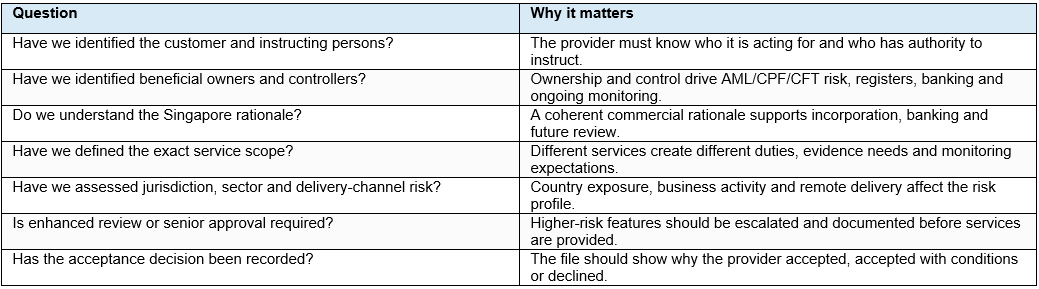
Customer onboarding should come before incorporation. Under Singapore’s Corporate Service Provider framework, a provider must understand the client, the proposed service and the risk profile before it acts.
For foreign business owners, this means incorporation will usually be smoother where ownership, business purpose, funding, intended activity and requested services are explained clearly at the outset. For Corporate Service Providers, acceptance is a decision that should be documented before corporate services are provided.
A well-prepared onboarding file is the first step towards a Singapore company that can be administered, banked, taxed and reviewed with confidence. It is not an obstacle to business. It is the foundation for a structure that can be maintained, explained and defended.
It is the process by which a Corporate Service Provider identifies the customer, verifies relevant persons, understands ownership and control, assesses the requested services, evaluates risk and records whether the relationship can be accepted.
Yes. A CSP should normally complete customer acceptance before forming a company or providing another regulated corporate service, because incorporation creates a structure that must be capable of being understood, documented and administered responsibly.
No. An enquiry is an initial contact and a quotation is usually indicative. Acceptance is a separate internal decision made after the provider has reviewed the information and risk profile.
The provider usually needs identity documents, ownership information, beneficial owner details, a business explanation, requested service scope, source-of-funds information, countries involved and expected transaction or banking profile.
Enhanced review may be required where there are complex ownership chains, nominee arrangements, politically exposed persons, adverse information, sanctions concerns, higher-risk jurisdictions, unclear funding, sensitive business activities or inconsistent explanations.
A higher-risk feature does not automatically require refusal. The provider should understand the risk, obtain appropriate evidence, escalate where required, document the decision and apply controls. If the risk cannot be understood or mitigated, the relationship may need to be declined.
Beneficial ownership shows who ultimately owns, controls or instructs the proposed structure. Without that analysis, later bank, tax, accounting and statutory-register processes may become inconsistent or unsupported.
Clients should prepare identity and address documents, corporate documents for entity shareholders, an ownership chart, a clear business rationale, expected activity and countries, source-of-funds explanations and any nominee or group-structure documentation.
Articles are provided for general informational purposes by an authorised corporate services provider and do not constitute legal advice.

Receive updates with practical insights on international business, law, tax, accounting, and compliance.
Be the first to hear about our latest discounts and special offers!
Follow our Telegram channel for offshore industry news:
Want updates by e-mail?
Enter your email address below to subscribe to our newsletter!